


The human penchant for worrying about the state of morality is ageless.
In the 1950s, the popularity of rolled-up jeans, slicked back hair and rock’n’roll music frightened Americans so much that many feared juvenile delinquency would be the ruin of society.
And today they are at it again, this time worrying that relativistic views of moral behavior are poisoning the nation.
At least that’s what LifeWay Research learned in a recent survey of 1,000 American adults.
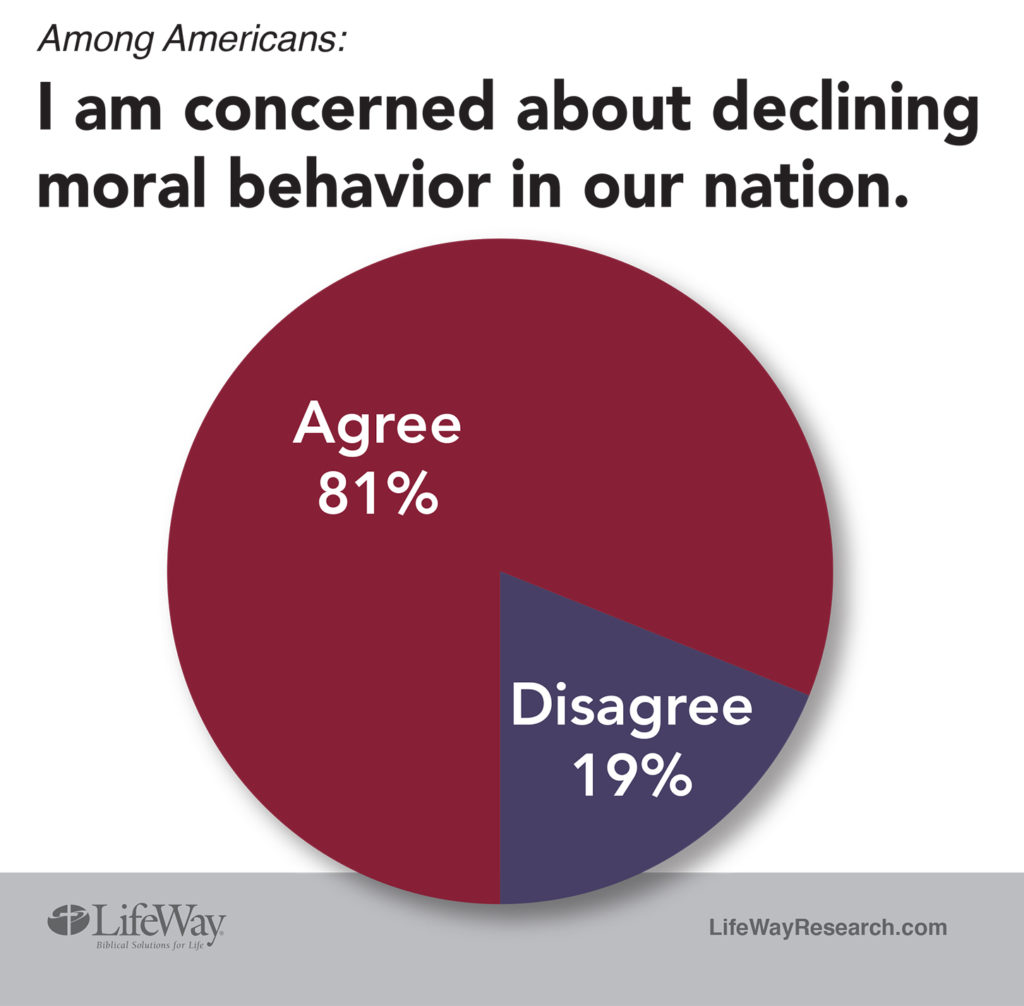 The Nashville-based organization said its survey reveals a significant generational divide on the subject of morality.
“More than 6 in 10 of those older than 45 say right and wrong do not change,” LifeWay reported in an online summary of its research. “For those 35 and younger, fewer than 4 in 10 make that claim.”
On some issues the concern is strong across age groups. For example, 85 percent of Americans 65 and older are worried about declines in moral behavior, LifeWay said. Among Americans 18-24, it was 72 percent.
The concern was similarly high across different ethnic groups. The LifeWay survey found that 86 percent of African Americans, 82 percent of whites, 75 percent of other ethnic groups and 73 percent of Hispanics are worried about that decline.
But the research also uncovered plenty of disagreement among Americans — especially about legislating morality.
When presented with the statement: “Implementing laws to encourage people to act morally is not effective,” 63 percent agreed and 37 disagreed.
Men were more likely to agree with that statement than women, while nones are more likely to agree than Christians.
LifeWay also asked people how they personally choose between matters of right and wrong.
Moral truths never change, according to 52 percent of Americans. Thirty-two percent believe whether someone is hurt determines right and wrong.
Whether an action is illegal or if the benefits outweigh the costs also influences its consideration as right or wrong.
“Overall, Americans seem guided more by their internal moral compass than by laws,” the LifeWay report stated. “Almost no one (4 percent) worries about getting caught when deciding between right and wrong.”
Other variables were also examined.
“Faith, geography, education and gender divide Americans when it comes to morals.”
Women, at 36 percent, are more likely than men, at 28 percent, to consider harm to others when determining the morality of actions.
Midwesterners are more likely to consider harmfulness than Southerners, by 37 percent to 27 percent, respectively, LifeWay found.
Americans with high school educations or less, at 26 percent; Christians, at 26 percent; and evangelicals, at 16 percent, are less likely to consider harm to others in considering what actions are moral or immoral.
 When respondents were asked what influences their moral views the most, 39 percent named their parents, while 26 percent named religious beliefs and 18 percent named their feelings.
Almost 65 percent of evangelicals credited their faith with shaping their moral vision. So did 51 percent of those who attend religious services at least once a month.
LifeWay Research Executive Director Scott McConnell said the statistics about evangelicals are no surprise.
But determining the source of right and wrong isn’t as clear for the rest of society.
“However, for Americans there is no most influential source of morality embraced by a majority,” he said in the LifeWay report.
What is clear is that worry and division are on the rise.
“We are shifting very fast from a world where right and wrong didn’t change to a world where right and wrong are relative,” McConnell said. “We are not all on the same page when it comes to morality. And we haven’t reckoned with what that means.”