

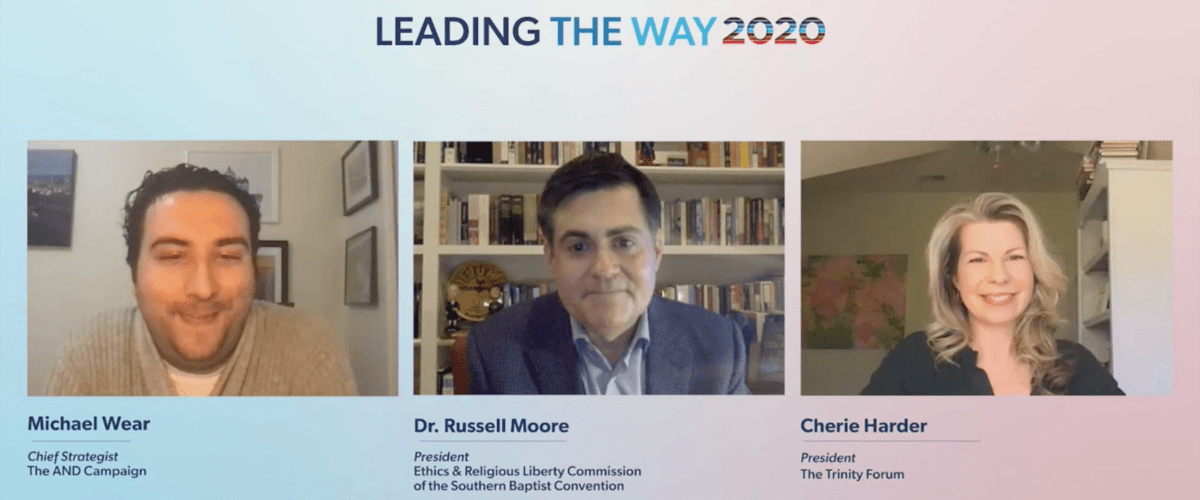
His name never was mentioned, but a Nov. 17 panel discussion on how to restore civility in public discourse drew a portrait of Donald Trump and his disciples as examples of what must be overcome.
And both speakers were conservative Republicans.
Russell Moore, president of the Southern Baptist Convention’s Ethics & Religious Liberty Commission, joined Cherie Harder, president of The Trinity Forum, for a discussion on civility moderated by Michael Wear of the AND Campaign. The conversation during the annual conference of The Immigration Forum reprised a similar panel discussion the previous year that proved popular with attendees.
More than 1,000 people registered for this year’s four-day virtual seminar, put on by the bipartisan organization focused on a wide range of immigration issues.
Moore
“I hate the word ‘civility,’” Moore said early in the discussion. “I’ll use it, but I have a higher bar, the biblical idea of kindness as the fruit of the Spirit. The reason for that is civility can mean in its worst iteration just a kind of polite way of destroying one another.”
He cited his experience growing up in the American South, where “there is a certain kind of kindness that also can be cutthroat.” Rather than that kind of “civility,” he said, “we need to be actively kind to one another.”
Learning to behave in this biblical way “has everything to do with shaping oneself,” Moore declared. “It’s not healthy to the soul for someone to have — as the Bible puts it — an unhealthy craving for controversy.”
Harder, a former Republican staffer on Capitol Hill, agreed, pointing to the “proliferation of apocalypse” in American civic life. A belief in a constant threat of apocalyptic proportions has led to “an increasing willingness to throw out the guardrails that once governed and constrained.”
And this is not just a religious idea, she said. “It is unhealthy to the soul and to the health of a nation as well. … And it makes it almost impossible to negotiate in good faith. How do you negotiate in good faith if you’ve just been called a cockroach?”
The kind of always-apocalypse that drives modern politics “turns any legitimate policy dispute … into a food fight where it becomes almost impossible to think clearly, rationally.”
Yes, Moore added, and it “also prevents you from being able to prioritize what is important and what is not. … If you can’t figure out what is just tribal posturing and what is a real emergency, it leads to numbness.”

Harder
Specifically as related to immigration in America, such apocalyptic language led to the demonizing of groups of people, Harder said. “There was a lot of language that actually seemed to aim at promoting the worthlessness of other people, talking about infestations, … referring to other countries as shitholes. It encouraged denying the humanity of other people.”
Language like this “distorts our politics but also distorts our character,” she said. “Language shapes what we think. … When we repeatedly use the kind of language that encourages the disgust of other people, it distorts our thinking.”
Americans now face a choice, Moore added. The aftermath of the 2020 election “could lead to a normalization of this kind of behavior, where we expect to pretend theatrically to hate each other … or could lead to people saying, ‘We’re tired, let’s find a better way.’”
Harder said she believes there is a “critical mass of people … who are increasingly tired of heat without light, the mudslinging that has made it difficult to see what is true and has tarnished our political process.”
America’s greatest political and social advances have not happened in the past 20 years of hyper-partisan rhetoric but instead in the post-World War II era in which there was healthy dissent but a concern for the common good, Moore said. “I would argue that incivility doesn’t work unless you’re going to end up with an autocracy with the most uncivil person in charge. But that’s not our system.”
Harder pointed to the Civil Rights Movement and Martin Luther King Jr. as examples of a better way to bring about change through persuasion rather than believing “the only way to triumph is by destroying your opponents.”
King “pointed a finger at moderate white clergy in the South,” she said. “But he left the door open to them to be able to hear him. … He appealed to common authorities and common reference points. … That’s very different from name calling, character assassination. Once anyone engages in an ad hominem attack, the chances of persuasion are almost nil.”
In her work on Capitol Hill, Harder said she noticed that among the more than 500 offices of senators and representatives each office tended to take on the character of the elected leader in charge. “Offices where the congressman or woman was affable tended to be affable, cheerful offices,” and offices with angry leaders fostered angry staff.
“Leaders can call us to the better angels of our nature, or they can validate and even institutionalize our worst instincts.”
“Leaders can call us to the better angels of our nature, or they can validate and even institutionalize our worst instincts,” she noted.
Moore added that in all realms of society, the actions of leaders “flow downstream for generations. Part of what has to happen is a long-term view that one is not just speaking to one’s opponents; you’re also speaking to those who are overhearing you. It changes their understanding of the possible.”
Then he quoted the Apostle Paul, who said, “Be careful when you bite one another that you do not devour one another.”
“If perpetual outrage is what you’re appealing to, you’re going to have to be permanently in that mode,” Moore said. “But what Jesus says is if you live by the sword you will die by the sword. … It is ultimately self-defeating. Nuclear weaponry works in terms of winning a war, but if that’s the routine way of doing foreign policy, you’re not going to have a planet long.”
“Jesus says if you live by the sword you will die by the sword.”
Harder encouraged “ordinary citizens” to understand they still have power to influence elected officials in Congress: “Most members of Congress have very finely tuned political antennae. If the stoking of fear and loathing doesn’t work and isn’t rewarded by their constituency, they will stop doing it.”
Her advice: “Stop contributing to that. Take a step back. Go to credible media as your source. Fact check things before passing them along. Be a conscientious objector in the ongoing Twitter war. … Model another way in your own life. You can actually be a spur to the imagination of others.”
Moore recounted a recent conversation with someone in an organization who was being hampered by a constituent who believes the moon landing was a hoax. While 99 out of 100 people believe the U.S. did in fact land on the moon, the voice of that one doubter can become all-consuming, he said, because the denier “really cares about it” while the other 99 people don’t organize their lives around their belief that this really happened.
Then he drew this analogy to the immigration debate: “Most people are for border security; most people are for a robust sense of American immigration. The problem is there are people who really, really care about the issue (negatively) and they are the ones who invest their voices. We need that middle group of people to care about this as much as those on the extremes.”
Related articles:
Panelists debate how to ‘normalize’ immigration after ill effects of Trumpism
Biden plans to restore refugee admissions, but rebuilding the system will take time
Faith-based groups unite to denounce Trump’s further gutting of legal refugee resettlement
The true story of two immigrants seeking asylum in the U.S. and the pastor who’s helping them