


The U.S. Supreme Court’s conservative majority seemed open April 30 to permitting the use of taxpayer dollars to fund the nation’s first religious public charter school.
Their reasoning during oral arguments about the case of St. Isidore of Seville Catholic Virtual School in Oklahoma “was most profoundly disturbing,” said Rachel Laser, president of Americans United for Separation of Church and State, after attending the session.
Some justices sounded sympathetic to the arguments of school proponents that receiving public funds is a religious right protected by the Free Exercise clause, Laser noted. “We saw a number of Supreme Court justices who seem to think church-state separation violates religious freedom rather than protecting it. They seem to think separating church and the government is a constitutional violation — that it’s a violation of the free exercise of religion rather than a guarantee of religious freedom.”
The proposal to open a publicly financed church charter school was first presented by the Catholic Archdiocese of Oklahoma and the Diocese of Tulsa in early 2023 and approved by the Statewide Charter School Board later that year. The idea was backed by Gov. Kevin Stitt but opposed by state Attorney General and fellow Republican Gentner Drummond, who asked the Oklahoma Supreme Court to reject the plan.
The board’s decision resulted in OKPLAC Inc. v. Statewide Virtual Charter School Board, a federal action by parents and faith leaders opposed to the school.

Holly Hollman, general counsel for BJC, speaks at a news conference after the Supreme Court hearing. (Photo by Iona Gordon/BJC)
The Oklahoma Supreme Court later ruled the state charter school board violated the Establishment clauses in the state and U.S. constitutions by agreeing to fund an online religious K-12 charter school
Writing for the majority, Justice James Winchester said St. Isidore cannot use the Free Exercise clause as a justification for receiving tax payer money when it intends to instruct students in the Catholic faith.
“Under Oklahoma law, a charter school is a public school. As such, a charter school must be nonsectarian,” he wrote. “This state’s establishment of a religious charter school violates Oklahoma statutes, the Oklahoma Constitution and the Establishment Clause.”
After their defeat at the Oklahoma Supreme Court, the plaintiffs in Oklahoma Statewide Charter School Board v. Drummond and St. Isidore of Seville Catholic Virtual School v. Drummond appealed to the U.S. Supreme Court.
When justices agreed to hear the St. Isidore case, observers wondered if the court was signaling another rightward shift on church-state issues. Its 6-3 majority already has overturned longstanding precedents by favoring free-exercise considerations over those prohibiting government establishment of religion.
Among the most notable was court’s 2022 Kennedy v. Bremerton School District decision siding with a high school football coach who held post-game prayer meetings with players at the 50-yard-line. Justices ruled the Constitution’s Free Speech and Free Exercise clauses protect individuals from government action.
Yesterday, the back-and-forth between attorneys and the justices — minus Amy Coney Barrett, who recused herself from the case — captured the legal and religious gulf separating opponents and proponents of state funding for St. Isidore.
Representing the Oklahoma charter school board, attorney James Campbell argued a favorable ruling for the school would increase educational choice in Oklahoma and protect organizers’ freedom to practice religion as guaranteed in the Constitution.
“Current state law “categorically bars religious groups and programs, deeming religion to be the wrong kind of diversity.”
Current state law “categorically bars religious groups and programs, deeming religion to be the wrong kind of diversity. That religious exclusion violates the Free Exercise Clause,” said Campbell, chief legal counsel for Alliance Defending Freedom.
Gregory Garre, the attorney hired to represent Oklahoma before the court, argued against public funding for St. Isidore because, unlike other charter schools, it was not created by the Legislature and is not under direct state control. It is operated instead by the Catholic Church.
Garre also addressed concerns expressed by justices Brent Kavanaugh and Neil Gorsuch that ruling against the religious school could jeopardize other religious entities that receive government funds, such as faith-based adoption agencies.
“Your honor, the adoption agencies and other faith-based contractors are not being established by the state as part of a system,” he said.
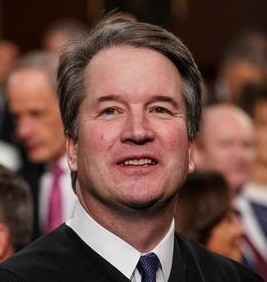
Brett Kavanaugh
But Kavanaugh stood up for St. Isidore. “All the religious school is saying is don’t exclude us on account of our religion. I mean, if you go and apply … to be a charter school and you’re an environmental studies school or you’re a science-based school or you’re a Chinese immersion school or you’re an English grammar-focused school, you can get in.”
Justice Sonia Sotomayor, however, questioned Campbell about his claim the free exercise of religion is not threatened by funding a private religious school with state money.
“So, what you’re basically saying … there’s no Establishment Clause really. What you’re saying is the Free Exercise Clause trumps the essence of the Establishment Clause because the essence of the Establishment Clause was we’re not going to pay religious leaders to teach their religion.”
Commenting on the case, Laser underscored the problem of using tax dollars to underwrite religious indoctrination: “The highest judges in our land have forgotten that separating religion and government is what protects religion and religious freedom, and that’s pretty sad and scary.”
Holly Hollman, general counsel for Baptist Joint Committee for Religious Liberty, pointed to the detrimental effects a favorable ruling for the school could have on civic life.
“Public schools are vital government entities essential to democracy, and they are properly bound to serve all students without regard to religion, and to avoid religious instruction and evangelism,” Hollman said in remarks aired on C-SPAN after the hearing.
BJC and the Cooperative Baptist Fellowship filed a brief on behalf of Christian, Jewish, Muslim and interfaith organizations in support of opponents of the St. Isidore proposal which “threatens to make public schools an arm of churches fully supported with tax dollars. We are very hopeful that petitioners attempt to fuse the institutions of religion and government will be rejected by this court.”

Paul Raushenbush
The St. Isidore plan may seem “pro-religion on the face of it,” but it comes with the sinister threat of government meddling in faith, Interfaith Alliance president and Baptist minister Paul Raushenbush said outside the court after the hearing.
“Taking government money invites government regulation. Becoming agents of the government will put the independence of religious institutions at risk. Religion flourishes best when it is free from government interference and government sponsorship.”
Shannon Fleck, executive director of Faithful America, joined Raushenbush in warning about the implications of a high court leaning right on matters of church-state separation: “If today’s arguments are any indication, the Supreme Court may be on the verge of abandoning one of the bedrock principles of our democracy. Let’s be clear, this was always a test case, and today, the constitutional protections that have guarded true religious freedom for generations are at risk.”

Erin Brewer
For the proponents of state-funded religious education, the issue is about money, warned Erin Brewer, the parent of two children and co-founder of the Oklahoma Parent Legislative Advocacy Coalition, lead plaintiff in OKPLAC Inc. v. Statewide Virtual Charter School Board.
“This case is not about faith, it’s about access to government funding,” Brewer said during an April 29 Americans United press conference with plaintiffs in the federal suit. If the Supreme Court sides with defendants, “every religious school in the country will demand to your taxpayer dollars.”
She urged parents to speak up for the First Amendment protections against government interference in the religious lives of families. “We as parents have come to realize that we are the last line of defense in protecting this uniquely American invention of public education.”
Forcing taxpayers to support religious institutions violates basic religious freedoms, said plaintiff and Baptist minister Mitch Randall, CEO of Good Faith Media. He lives in Norman, Okla.
“The government should not be creating public schools that indoctrinate students in any religion, even my own,” he said. “Doing so violates our religious freedom. Children should not be made to feel unwelcome in public schools because of their beliefs. Doing so violates the bedrock principle of religious freedom.”
Related articles:
Oklahoma Supreme Court says Catholic charter school unconstitutional
Supreme Court will hear Oklahoma charter school case
Opponents file suit to stop unprecedented Catholic charter school in Oklahoma