

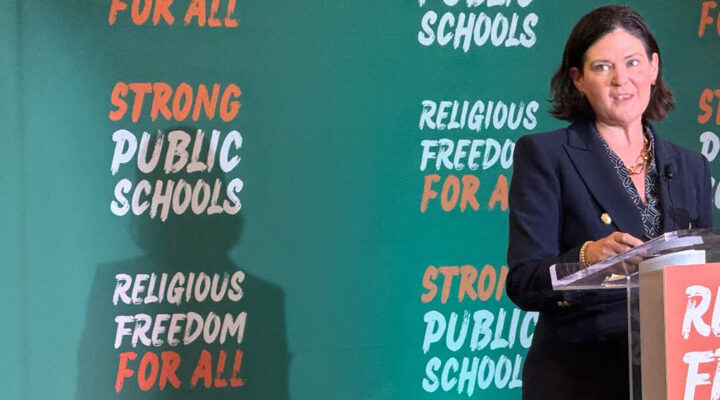
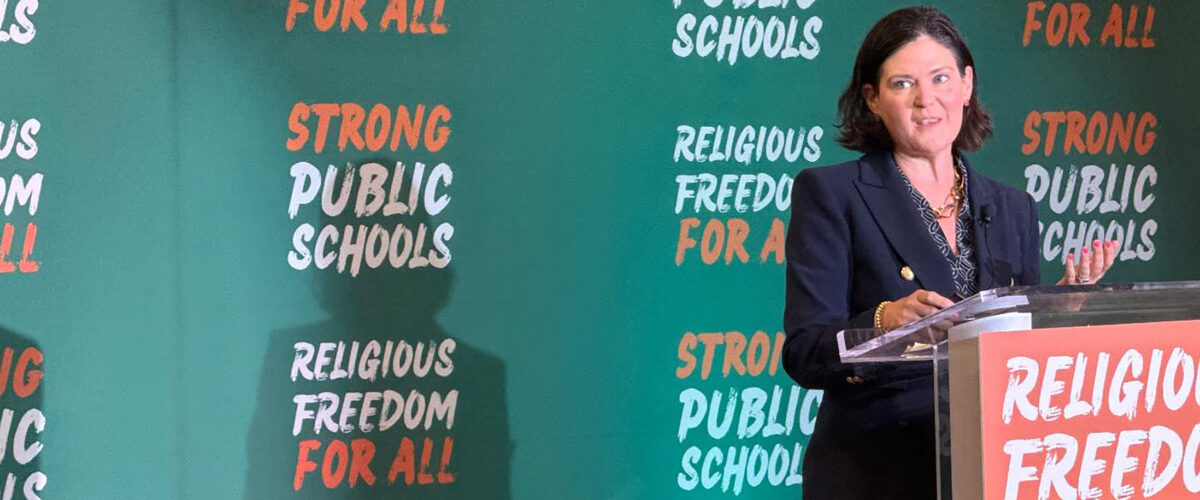
The new “Bluebonnet” curriculum in Texas furthers the mythology of America as a Christian nation and tries to “indoctrinate that history at a very early age for young Texans,” according to Amanda Tyler.
Tyler, who leads Baptist Joint Committee on Religious Liberty and the group Christians Against Christian Nationalism, was among 15 speakers at the Sept. 15-16 summit on religious freedom in public schools sponsored by Interfaith Alliance and convened in Dallas.
The new state-approved curriculum offers a “false history” and a “cherry-picked history,” she warned. But what was proposed originally was even worse, she added, saying critics of the curriculum made some gains.
“I’m here this morning to provide a case study, a roadmap if you will, for what advocates in states like Texas and other places around the country can do to push back against these incredibly extreme policies we’re seeing pop up,” she said.
Goldilocks and Jesus
Her presentation preceded a talk by Mark Chancey, religion professor at Southern Methodist University, who introduced some of the problematic aspects of the Bluebonnet curriculum.

Mark Chancey (Photo by Mitch Randall/Good Faith Media)
“The way these lessons handle the Bible is very, very problematic, to say the least,” Chancey said. “There are 11 lessons that focus solely on biblical topics. … For example, there’s a lesson on Solomon. There are two lessons on Esther. There are multiple lessons on Jesus and his teachings and present these lessons as if they are straightforward, generally accepted history, which is of course a religious claim. … There is a lesson on the 23rd Psalm that suggests King David himself wrote it in King James English.”
Even more amazing is the inclusion of a story on Esther — an Old Testament account that never mentions the name of God. But the Bluebonnet curriculum “added material saying the story is about Esther’s great faith in God,” he noted. “They took a Bible story and decided they needed to make it more religious.”
“They took a Bible story and decided they needed to make it more religious.”
The curriculum also “found a way to Christianize the story of Goldilocks and the three bears. Do you think Goldilocks was thinking about Jesus’ teaching to do unto others as you have done to you as she broke into the bears’ house? I don’t think so.”
While lessons from Jewish Scripture are infused into the curriculum, “How many lessons focus on the sacred stories or Scripture of other religious traditions? Not a single one.”
Small victories
Despite these problems, the Bluebonnet materials in their current form “are much, much, much stronger than the original proposed versions were. Thanks to the activism of many of the people in organizations in this room, we were able to get changes made that at least made them significantly better.”
And that’s where Tyler picked up the story, as both head of BJC and as the parent of a child in Texas public schools.
She and others led the charge to read through thousands of pages of the proposed curriculum and to travel to Austin to testify against the religion-infused parts. Do not underestimate the power of working together, she said.
“Our democratic system is not easy for people to navigate, and I’m not just talking about voting or making our views known,” she explained. “So as long as our institutions continue to allow public comments — and this is not a freedom we should take for granted in this moment — we need to learn how to navigate the process and do it well.”
Because of the investigation and advocacy by critics of the curriculum, members of the state board of education became informed, Tyler reported. And they started asking questions. And it turns out the Texas curriculum originated from Hillsdale College, the far-right Christian nationalist school favored by the Trump administration.
“As long as our institutions continue to allow public comments … we need to learn how to navigate the process and do it well.”
At the public comment session offered before the State Board of Education, hundreds of opponents of the curriculum showed up — Christian, Jewish, Muslim, Sikh, humanist, atheist and others. “It’s important to show up, to show up in these places and to show up with all our identities including our religious identities. We outnumbered (supporters of the curriculum) 10 to one in the public comments. We outnumbered them three to one with people who actually showed up to testify in person.”
Tyler played video of one of the Christians who testified against the Bluebonnet curriculum, a woman named Sarah.
“My parents did not send me to Sunday school to learn how to read. My parents did not send me to Sigler Elementary in Plano in 1965 to learn about Jesus. Incorporating Bible stories into the reading curriculums of our public-school classrooms is a not so thinly veiled attempt at indoctrination. It removes the rights of parents to bring their children up in the faith context of their choosing and presents a skewed view of Christianity as the only possible faith choice. That is un-American and in a state like Texas that values independence and freedom, curriculum like this should be thrown out of this building.”
Tyler and other opponents of Christian nationalism showed up to testify in September and November.
Bipartisan opposition
While the curriculum as adopted is still full of problems, some changes were made, Tyler reiterated. “Something else that happened along the way is this was a bipartisan vote against the curriculum. It passed eight to seven. The seven were made up of four Democrats and three Republicans.”
“Even though this curriculum passed, this was a win for local organizing.”
The deciding Republican vote was cast by a person appointed by Gov. Greg Abbott just days before the vote to ensure passage, Tyler said. “They thought this bill was going to pass so easily that they didn’t need to bother about that seat, but then they did because that was the deciding vote.”
While from one perspective church-state separationists lost the battle for curriculum in Texas, there’s another way of seeing some wins, she added. “Even though this curriculum passed, this was a win for local organizing because we built relationships, we trained people on how to show up and file comments and we made it bipartisan in the opposition to this particular curriculum.”
Now that same coalition is working on the local level to speak with superintendents and school boards about their concerns with the curriculum. But there, they’ve run into another problem, Tyler said: The state is bribing school districts to adopt the curriculum by offering them an extra $60 per student if they use the new curriculum.
“Since we know school districts are already vastly underfunded, it puts local schools in a terrible choice about how they’re going to continue to educate their students,” she said. “But even with that really pernicious piece of this policy, we have found out … only about one in four school districts have actually adopted this reading curriculum so far. And those that have, many of them are adapting the curriculum and taking the Bible stories out of the curriculum.”
The story is still evolving, she said. “We must never give up. Even when there are extreme policies passed by those policymakers in our jurisdiction, we still have enormous people power to do something about it and to raise the concerns in and with our communities to make a difference for all of us.”
Related articles:
Here’s why the new Texas school curriculum is so very, very bad | Analysis by Mara Richards Bim
The shocking things I witnessed at the Texas Board of Education | Analysis by Mara Richards Bim
Texas Board of Education gets huge pushback on religion-infused curriculum
Proposed new Texas school curriculum infused with Bible stories