


In further efforts to rid the nation of undocumented immigrants, the Trump administration has unveiled a national registry for anyone in the country illegally to submit their personal information or face fines and prison time.
Launch of the registry was reported by the Wall Street Journal and other media outlets Feb. 26.
The registry — and the double threat it conveys — furthers the administration’s hard line on immigration and its desire to deport as many undocumented immigrants as possible. The White House already has the power to deport any person in the country illegally — pending due process of the legal system often overlooked by Trump — and the registry asks these very people who do not want to be found to identify themselves or face the same threat they already face. Trump also shut down the CBP-1 app that was the preferred means to immigrants to register with the U.S.
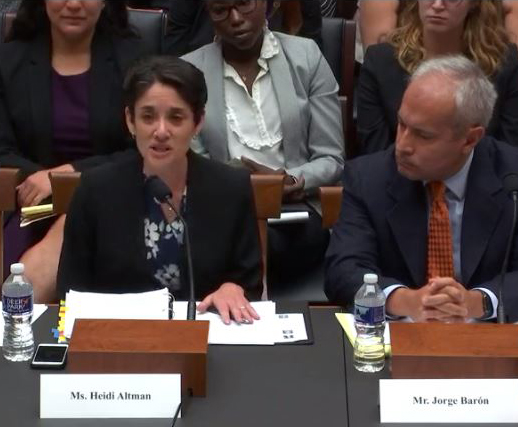
Heidi Altman testifies before the House Judiciary Committee September 26, 2019, hearing on the expansion of the ICE detention system.
“The Trump administration’s registry announcement harkens back to shameful episodes in U.S. history of government-sanctioned discrimination against immigrants and people of color,” said Heidi Altman, vice president of policy at the National Immigration Law Center. “All of us must reject this transparent attempt to criminalize, entrap and spread more fear and confusion in our communities. No good has ever come out of forced registries that subject people to racial profiling and tee up entire communities to be targeted for detention and deportation.”
People already living below the legal radar are unlikely to register, which would make them far easier to deport, a legal scholar told ABC-7 in Los Angeles.
“Even if it doesn’t actually accomplish much in terms of deporting more people, it sends a signal to the American people that ‘we’re cracking down on immigrants,’ and it will also heighten the fear immigrants already have about what’s going on,” said Stephen Yale-Loehr, immigration law scholar and retired Cornell Law School professor.
Under Trump’s plan, immigrants in the country illegally — including children 14 and older — would be required to submit fingerprints and home addresses to the registry. Those who qualify for asylum but fail to register could be fined up to $5,000 and sentenced to up to six months in prison.
The Trump administration has advanced the language that those in the country illegally have committed crimes and therefore should be considered criminals — even if they already have filed claims for asylum and are working through the legal system.

Kristi Noem
“Aliens in this country illegally face a choice,” Homeland Security Secretary Kristi Noem wrote in a memo on the new policy. “They can return home and follow the legal process to come to the United States or they can deal with the consequences of continuing to violate our laws.”
Immigration advocates — while not suggesting anyone cross the border illegally — counter that the U.S. immigration system is so broken and so backlogged that it is not realistic for those fleeing violence in their homelands to wait years to “follow the legal process” as Noem suggested. Already immigration courts have multi-year backlogs and now Trump has been firing immigration court judges, which will make the backlog even greater.
Immigration advocates say Trump’s intent is to make it impossible to legally immigrate while classifying anyone who attempts to immigrate as a criminal.
There is some legal precedent for a registry, but that history is fraught with controversy.
In 1940, Congress passed a law creating an immigrant registry to catch suspected communists. That system was abandoned by the 1960s but appears to be the legal basis for the Trump registry.
After 9-11, President George W. Bush created an immigration registry requiring men and boys from predominantly Muslim countries to submit photographs and fingerprints to the federal government. According to the Washington Post, tens of thousands of people who registered under that program were arrested and deported.
The Immigration Law Center says of that episode: “Purporting to address national security concerns, the U.S. government forced 83,000 people to register … and placed 13,000 of them in deportation proceedings. The government obtained zero terrorism convictions, all while supercharging racial profiling and tearing families apart. Many communities still live with the pain caused by the deportations of loved ones.”
Trump ordered the federal registry in one of his Day One executive orders. That order was titled, “Protecting the American People Against Invasion.” The opening paragraph of that executive order contains documentable false information, saying under the Biden administration “millions of illegal aliens crossed our borders or were permitted to fly directly into the United States on commercial flights and allowed to settle in American communities, in violation of longstanding federal laws.”
The next paragraph also conveys incorrect information: “Many of these aliens unlawfully within the United States present significant threats to national security and public safety, committing vile and heinous acts against innocent Americans.”
The registry is sure to face legal challenges.
This order “rests on a half-a-century-old law and is reminiscent of shameful historical examples of race- and nationality-based registry requirements in the United States,” according to Immigration Law Center. “The provision is also confounding because no universal, separate process currently exists for the registration of noncitizens in the United States.”
Related articles:
CBF and coalition win temporary order against ICE raids in churches
Now Trump administration is targeting immigrant children
The return of public racism | Analysis by Rodney Kennedy