


There are Christians in America who can tell you exactly what righteousness looks like in somebody else’s bedroom but cannot recognize injustice in their own neighborhood.
They know which sins keep a person out of the pulpit. They know which marriages God approves. They know which books should disappear from school libraries.

Charlie Dates
But ask about the Black body afraid of a traffic stop, the immigrant body disappearing into detention, the poor family choosing between rent and groceries, the child buried in Gaza, the LGBTQ teenager wondering whether there is a church where they can survive, and suddenly the Bible gets quieter.
Or the version of it American Christianity has chosen to read does.
Charlie Dates would like a word.
Dates, senior pastor of Progressive Baptist Church and Salem Baptist Church in Chicago, has written a book with an old-fashioned title: What Hath Justice to Do with Righteousness? Reclaiming the Intersection of Protest and Prayer. His answer is everything, and it rests on a single claim: Justice is God’s righteousness in action.
“Justice is God’s righteousness in action.”
That sentence is the hinge of the book. Dates says his purpose is to “train the eyes of the American Christian” to see the intersection anew. He is not arguing Christians should care more about justice. That would be easy. Any church can add a service project, host a food drive, issue a statement after another tragedy and congratulate itself for becoming justice minded.
He is making a more disruptive claim, and his table of contents states it plainly. Chapter one is “The Divorce of Righteousness from Justice.” Chapter two, working through the Old Testament vocabulary, is “A Marriage Made in Heaven.” Chapter three, moving into the New Testament, is “A Vow Revisited.”
The metaphor is not decoration. Dates believes American Christianity performed a theological divorce, and he spends the book arguing the marriage never was ours to dissolve.
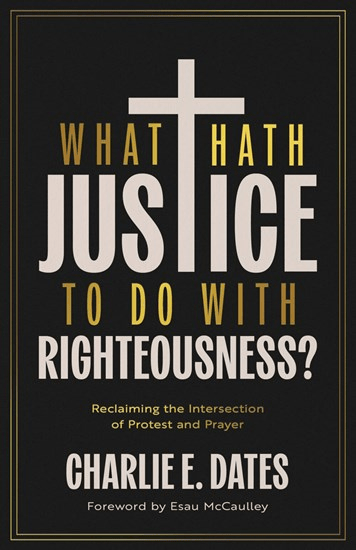 In tracing the Old Testament vocabulary, Dates centers the Hebrew pairing of mishpat and tzedakah, justice and righteousness, words Scripture keeps placing beside one another. They are not competing categories in the biblical imagination. Separating them is less an act of interpretation than an act of theological amputation.
Somewhere along the way, large portions of the American church decided righteousness is primarily personal. Whether you drink too much. Whether you have sex before marriage. Whether you believe the correct doctrine and behave yourself. Justice, meanwhile, became political.
Talk about salvation and you are preaching the gospel. Talk about poverty and you are getting political. Talk about personal morality and you are being biblical. Talk about racism and you are being divisive.
Somebody forgot to tell the Bible.
Amos looked at people singing worship songs while their society crushed vulnerable people and told them God was tired of listening. “I hate, I despise your festivals,” God says through the prophet. “Take away from me the noise of your songs.”
Then comes the line we still quote while avoiding its implications: “Let justice roll down like waters, and righteousness like an ever-flowing stream.”
Notice what Amos does not say. Let justice roll over there and righteousness over here. Same stream.
“They got religion right and righteousness wrong.”
Isaiah does the same thing. Micah does the same thing. Jesus does it too. When he condemns the religious leaders in Matthew 23, he does not accuse them of having no religion. These are people who tithe meticulously. But they have neglected the weightier matters, justice and mercy and faithfulness. They got religion right and righteousness wrong, because they could not see that righteousness included how they treated people.
That sounds contemporary. We have churches full of people who can defend biblical inerrancy but not their vulnerable neighbor. We have Christians who will fight to hang the Ten Commandments in a classroom and show considerably less interest in whether the children inside it have eaten. We have believers preoccupied with whether America is a Christian nation and strangely uninterested in whether America behaves like anything Jesus taught.
The subtitle may matter as much as the title. American Christianity loves a false choice. Faith or works. Evangelism or justice. Progressive or Christian. Prayer or protest. Pick one.
The Black Church rarely has had that luxury. Our ancestors prayed before they marched. They sang hymns on the way to jail. They held mass meetings in sanctuaries and then walked outside to confront sheriffs, segregationists and systems that had learned to quote Scripture while denying Black people their humanity.
Martin Luther King Jr. never had to choose between being a Baptist preacher and a Civil Rights leader, because his understanding of the gospel made the distinction nonsensical. The march was what happened when the prayer meeting got up on its feet.
“The march was what happened when the prayer meeting got up on its feet.”
Talking with Esau McCaulley on “The Holy Post,” Dates set King alongside Billy Graham: two preachers, the same decade, the same country, opposite answers about what the gospel required of them in public. That contrast is his argument in biography. People being lynched needed a gospel that had something to say before heaven. People denied the ballot needed a gospel that mattered before heaven. People watching Black bodies die in the street still do.
Here is where the book becomes more interesting than its category suggests. It would be easy for progressive Christians to read Dates, nod vigorously and assume he means somebody else. Those evangelicals. Those fundamentalists. Those Southern Baptists, a body Dates himself left. And there is plenty there to critique. He challenges an evangelicalism capable of enormous theological precision and painful inconsistency in applying it. Dates fears some evangelical formation produces “less compassion” for the hurting and “less courage” against injustice.
But Dates does not stop there. He also warns about a Christianity that pursues justice while losing righteousness. Some churches know how to pray and never protest. Others know how to protest and have forgotten how to pray.
Those of us in moderate and progressive Baptist life should sit with that second sentence longer than is comfortable.
It is possible to hang a rainbow flag outside your sanctuary and never know your LGBTQ neighbors. It is possible to say Black Lives Matter while your congregation stays almost entirely white and your leadership stays whiter. It is possible to celebrate King every January while carefully avoiding the economic and political critique that made him unpopular while he was alive. It is possible to talk about justice so often that the word becomes the church’s branding rather than its discipleship.
“He also warns about a Christianity that pursues justice while losing righteousness.”
I have preached justice loudly from pulpits and still gone quiet in rooms where telling the whole truth might cost me something.
Justice that never costs anything should make us suspicious. Amos is not asking Israel to update its mission statement. Isaiah is not recommending a task force. Jesus is not asking the rich young ruler to put economic justice in his bio. Something must move. Something must be surrendered. Someone must be liberated.
Perhaps that is why we worked so hard to separate the two in the first place. Keeping them apart makes discipleship easier. If righteousness is entirely personal, I can pray every morning, read my Bible, give money to my church, believe all the right doctrines and never ask why the neighborhood 5 miles away has a different life expectancy than mine.
I can be a good Christian without ever becoming a troublesome neighbor.
On “The Russell Moore Show” in September, Dates said American Christianity can become more American than Christian. There may not be a better diagnosis of the moment. He also described holding a healthy cynicism about where the American church is headed, alongside the kind of hope you need when the evidence runs against you. Coming from a pastor of two Chicago congregations, that is not despair. It is arithmetic.
Because Scripture keeps introducing us to a God stubbornly concerned with everybody else. The widow. The orphan. The immigrant. The prisoner. The person lying beaten on the side of the road whom respectable religious people have learned to walk around. God keeps asking Cain about Abel, and Cain keeps answering like an American: Am I my brother’s keeper?
Apparently, yes.
At 160 pages, this book is not an exhaustive treatment, and readers hunting for policy will not find it here. What Dates offers instead is the thing many justice books skip. Not another appeal to care, but the exegetical case that the separation never was legitimate to begin with.
If righteousness names something about the character of God, and justice names what that character does when it meets suffering, then Christians cannot claim the one and abandon the other. Dates gives the union its most explicitly Christian form in one compact sentence: “When Jesus hung on a Cross, God got justice, and we got righteousness.”
So what hath justice to do with righteousness? Everything. Justice is righteousness with its work clothes on.
Braxton Wade
Braxton Wade is a Clemons Fellow with BNG. He is a graduate of the University of Richmond and Chicago Theological Seminary and lives in Richmond, Va. He is currently a Ph.D. student at Yale Divinity School.