


A fun fact about me is that I am something of a generational mutt.
While my generational experience is decidedly Gen X, I am one of the world’s youngest Boomers. Both my parents were born prior to 1940, and my father was a World War II veteran. This war, rather than Vietnam, was the defining experience of his young adulthood. As a result, my 1980s childhood was as infused with the Second World War as much as it was with He-Man, Star Wars and MTV.
At the dinner table, dad regularly would tell us about things he did and saw as a signalman aboard the USS Wasatch, an amphibious force flagship assigned to MacArthur’s 7th fleet. In those early days of basic cable, the upstairs TV always seemed to be showing a World War II documentary when it wasn’t tuned to a Cardinals baseball game.

Ben W. Thomason Jr. as a fresh recruit in 1943.
In the summer of 1993, the long drive from North Carolina to Kentucky for a family wedding provided, in dad’s estimation, the perfect opportunity for my brother and me to savor the complete speeches of Winston Churchill. I cannot recall ever being more thankful to Sony for inventing the Walkman, which our mother mercifully allowed us to deploy after the first hour or so.
In hindsight, I wish I had paid more attention to dad’s stories and asked more questions along the way. I did come to my senses enough in January 2006, while home visiting for New Year’s, to record dad talking with me about the start of the war and his experience joining up. For the 80th anniversary of VJ Day (Aug. 15), when Japan formally surrendered to the Allies, officially bringing World War II to an end, I went looking for those recordings. I had not listened to them since dad died in August 2016. As the warm sound of his genteel South Carolina accent flowed through my earbuds, I found myself missing the American spirit he articulated as much as I miss him.
The first thing that struck me about dad’s recollections was how far and fast the war expanded his horizons. Within a matter of weeks, this 18-year-old teenager, born in Edgefield, S.C., and raised in Brevard, N.C., found himself on a train to basic training in Bainbridge, Md., then on to signal school in Newport, Rhode Island.
Along the way, he experienced weather he never had encountered before — he vividly recalls seeing the Delaware River frozen solid — and met all manner of people from up and down the eastern seaboard. At various points in his narrative, dad speaks about a bunk mate from Brooklyn who was as homesick as he was, a straight-shooting Polish barracks supervisor, and a “Jewish fella named Stone” who spoke up on dad’s behalf one morning when he was erroneously reprimanded for oversleeping.
“The Navy chucked dad into the deep end of the great American melting pot, and I think dad would agree they were all better for it.”
The Navy chucked dad into the deep end of the great American melting pot, and I think dad would agree they were all better for it.
One of the earliest (and more humorous) bonding experiences dad recounts occurred at the start of signal school. They arrived in Newport after dark only to discover the barracks there did not contain bunks as was customary. Instead, they were required to sleep in their standard-issue hammocks, which had to be put up each night and taken down each morning. However, they had not received instructions on how to properly set up these hammocks, so they had to wing it.
That first night’s sleep was restless, made uneasy both by the strange sensation of the hammock and the frequent loud thuds and exclamations of sailors falling out onto the floor. Dad recalls he was one of only three or four in the group who didn’t tumble out at least once. A day or two later, an officer finally showed them how to string up the hammocks properly, taut and secure, but by then dad’s company had largely helped each other figure it out. They also discovered they could make the hammocks wider and more comfortable by inserting foraged sticks of a particular length at either end.
Such forced togetherness did not bring out the best in everyone, of course. While dad and his fellow enlisted men tended to look out for each other, some of the lower-ranking officers delighted in wielding power for its own sake. The barrack chief in Bainbridge who mistakenly put dad on report for oversleeping wasn’t the chief for dad’s floor. He was assigned to an adjacent barracks, but he would do revelry checks regularly in other quarters as well, seemingly for the thrill of writing up as many recruits as possible. Then there was the mess hall chief whom dad describes as “the biggest, meanest man” he had ever met. If anyone in line made a sound above a whisper, he would clap them with scullery duty, which was one of the more unpleasant details to which recruits could be assigned.
Sailors of all ranks also took selfish advantage of others for personal gain from time to time. As basic training drew to a close, dad came down with a persistent fever. He spent his last few days of boot camp in the sick bay and was even too ill to travel home at the start of holiday leave. Once he rallied enough to make it to Brevard, the fever came back almost immediately, and he ended up staying for three weeks under the care of his local doctor. The Navy wanted him completely well before he returned. When dad at last received a clean bill of health, he reported back to Bainbridge only to find his seabag had been rifled through, and nearly half of his regulation clothes and equipment stolen — items he had to replace at his own expense.
“No age is as golden as it appears in hindsight.”
I include these latter accounts not only for historical accuracy but also as a hedge against the increasing nostalgia I feel for my childhood, dad’s wartime stories and the man himself. No age is as golden as it appears in hindsight. Any nation’s military is as inherently violent as it is disciplined, and there are aspects of America’s conduct in the Second World War that are rightly critiqued.
My father was flawed in the ways that all of us are flawed — in ways my younger self could itemize more quickly and completely than my older self. Not everything he and his generation valued or pursued — both during and after the war — was noble or for the better, even if they have been dubbed “The Greatest Generation.”
As George C. Scott quips in Patton, “War is hell,” and I’m sure there are plenty of things dad did, said, witnessed and/or participated in aboard the Wasatch of which he never spoke and perhaps tried his best to forget. However, reflecting on his life from my vantage point, on balance his better angels carried the day.
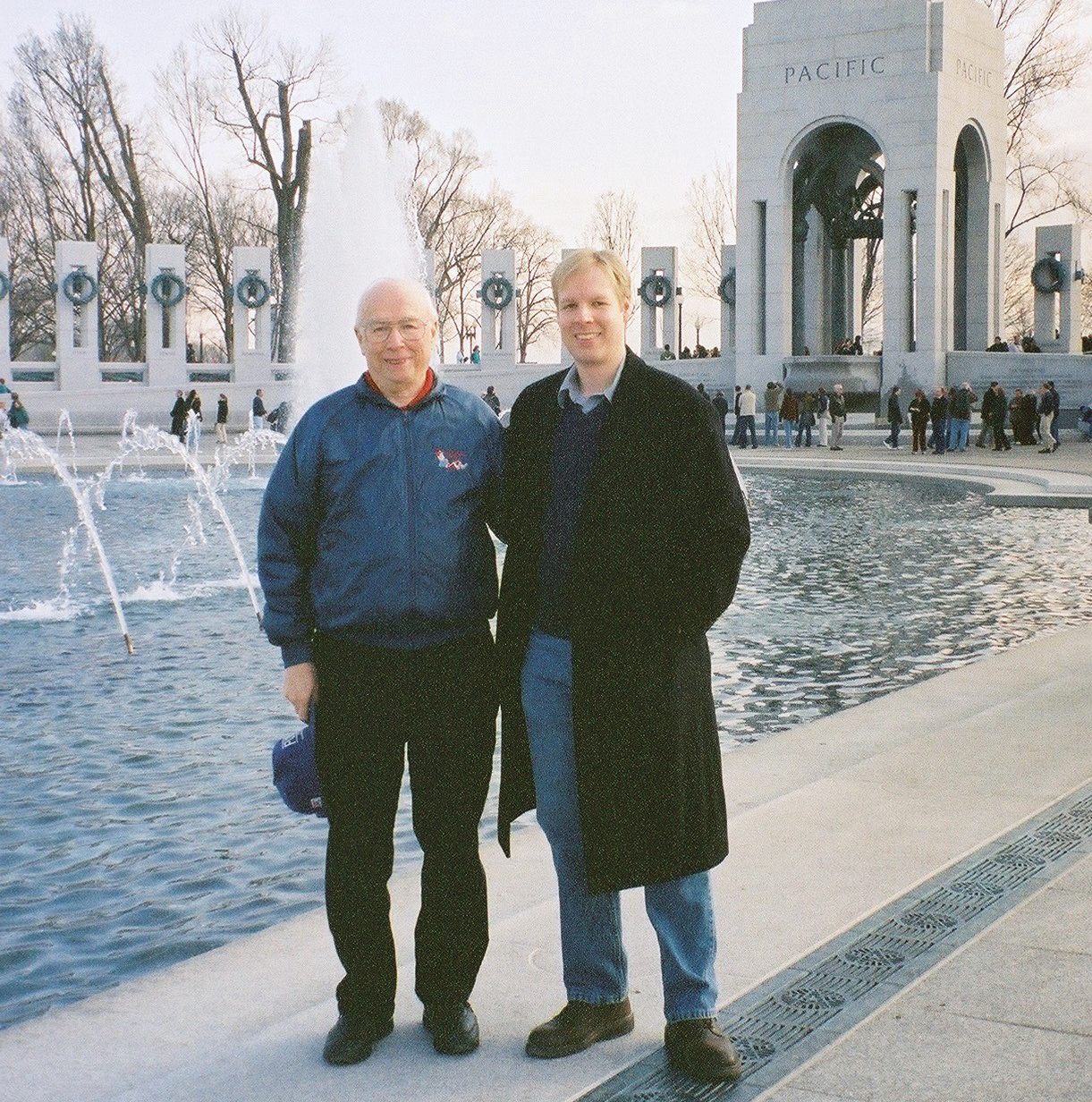
Todd Thomason with his father at the World War II memorial in Washington, D.C.
When I was 18, I thought I had all I could handle trying to finish high school, apply to college, and run a D&D campaign for my circle of friends. At that same age, dad was sending, receiving and relaying messages in real-life combat scenarios — communiques that had literal life and death implications. If he missed something or got something wrong, the consequences could be dire — for himself and others.
He and the rest of the Wasatch crew, from the top brass all the way down, knew they depended on each other. They either pulled together or they would go down together. That spirit — an emulsion of shared sacrifice and service to a larger mission — stayed with dad for the rest of his life and informed his approach to business, church and community in ways big and small.
In that vein, one of the things I regret not asking dad about was a handwritten letter I saw in passing on another visit home some years later. I was using the printer in dad’s corner office in the den. He was in his recliner watching a ball game. I spied the note while rummaging on his desk for a stapler.
I do not know who it was from, but I gathered from the few words I took in that it was a former business associate. The author was reminiscing about their pre-retirement days and lamenting how the business climate had changed. I don’t remember the specific words, but the sentiment struck me: everything now is about profit for profit’s sake. There’s no larger purpose, no larger vision, and the ends justify the means.
I had every intention of asking dad about it later but somehow never did. Whatever I was printing must have been (or seemed) important at the time and I was soon back upstairs carrying on. No doubt it was an opportunity lost. But I treasure the memory of those few words. Even without the larger conversation I had intended, they speak volumes about both the sender and the receiver.
Revisiting these memories now, in the context of Donald Trump’s boorish brand of authoritarianism and his domineering hold on politics and social discourse, makes me realize how much all of us have lost in these last 10 years.
I’ve lost a father, but America has lost something larger: a public facing ethos that life, work, church, community, the country should mean something more. That we hold these truths to be self-evident. That challenges and injustices, no matter how fierce and foreboding, can be named, faced and overcome through activism and mobilization.
It’s no accident of history that the push for civil rights, women’s rights and LGBTQ rights in America followed in the wake of World War II. Americans of all ages experienced firsthand what was possible when people pulled together for a shared purpose. On the home front and overseas, those who served the war effort learned that things did not have to be the way they had always known them.
We didn’t lose this ethos overnight or even in one election cycle, of course. We haven’t even lost it. It’s very much still with us; it’s simply been eclipsed in the marketplace and the public square by the performative indignations and fear mongering of wealthy white patriarchal reactionists whom we have naively and meekly allowed to accumulate larger and larger swaths of the nation’s assets and media outlets over the course of decades. The conglomeration of America’s corporations has led not only to a consolidation of market share but also the concentration of wealth and political clout in the upper echelons of the ownership and investor class.
“The sidelining of a defined larger purpose is why America has lost its way in more recent times.”
The sidelining of a defined larger purpose is why America has lost its way in more recent times.
On Pennsylvania Avenue, ideological entrenchment and the accumulation of personal power have long displaced governance. Politicians of both parties defer to their donors rather than their constituents.
On Wall Street, the pursuit of short-term profits that result in higher dividends and bigger bonuses drives boardroom strategy.
Even on Main Street, everyday Americans are living increasingly isolated, individually defined lives. Most of us are in work and community for ourselves and our tiny, disconnected tribes. We’re not really cooperating to make society better for us all, even if we pay lip service to the idea; many of us are simply trying to build enough personal wealth to insulate ourselves from the nation’s problems, which is becoming increasingly difficult since the richest 1% of Americans now have 35% of the nation’s assets all to themselves. Others of us are resigned to simply try our best to scrape by.
And so, as we mark the 80th anniversary of the Allied victory in World War II, my hope is that we, as a nation, will not only remember the victory itself but also how we won it and why we fought for it: In partnership with one another and with other nations against the tyrannies of fascism and ultranationalism.
Contrary to what some will declare, it was not simply the overwhelming superiority of America’s “greatness.” Throughout our history, whatever measure of greatness and progress we ever have achieved has resulted always from cooperating branches, divisions, companies, vessels, unions, societies, congregations and individuals pulling together in service to a larger cause and in hope of securing the blessings of liberty for ourselves and our posterity.
That’s the way forward now as much as it was then.

Todd Thomason
Todd Thomason is a gospel minister and justice advocate who has served as pastor of churches in Virginia, Maryland and Canada. He holds a doctor of ministry degree from Candler School of Theology at Emory University and a master of divinity degree from McAfee School of Theology at Mercer University. Currently, he is a Ph.D. candidate in New Testament and Christian origins at the University of Edinburgh in Scotland. In addition to Baptist News Global, Todd writes at viaexmachina.com.