


Newly elected Southern Baptist Convention President Willy Rice has characterized the SBC’s clergy sex abuse crisis as a “hoax” and a “snipe hunt.”
Talk like that helped get Rice elected. Apparently, it was the message many Southern Baptists wanted to hear.
But just eight years ago, Rice was expounding a very different message.
In 2018, on his “Pastor’s Blog,” Rice published “Another SBC ‘Me-Too’ Story” in which he spoke out about church leaders who “fail in their responsibilities due to our unwillingness to reckon with difficult things.”

“In seeking to protect institutions,” he wrote, “we fail people, we fail Jesus and, ultimately, we fail those very institutions we love. Many of us may wish we could hear no more, but that is the very attitude that betrays us in the first place. We wish to be comfortable when what we need is courage.”
Rice then told the story of how, as children, two of his relatives were sexually assaulted by a director of missions for a local Baptist association in Alabama. According to Rice, the man previously worked as a missionary with the SBC International Mission Board, and his personnel file documented “allegations and evidence of numerous sexual assaults of children while he worked overseas.”
“It’s been 25 years,” Rice said then, “but the wounds are still real, wounds that were put there not only by monstrous acts but also by spiritual leaders who failed to act, who failed to protect, and who failed to expose the truth.”
The children’s parents tried to seek help from key Southern Baptist leaders, but in Rice’s words, they were “shunned, shushed and shamed.”
“At every turn, they were stonewalled and treated like the enemy,” he recounted. “It’s hard to say which caused the deepest damage,” the sexual assaults or “the silence and lack of support from denominational and pastoral leaders all of whom played a game of cover and protect.”
Then Rice asked this question: “Have we learned the lessons?”
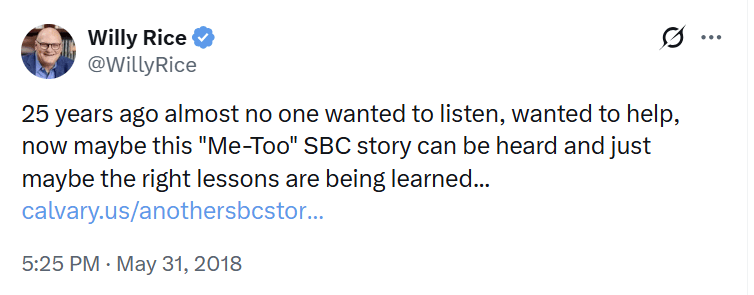
Now, in 2026, the answer is obvious. No. Southern Baptist leaders have not “learned the lessons.”
Rice’s most recent remarks — downplaying the abuse crisis as a “hoax” and a “snipe hunt” — are demonstrative of that tragic refusal to learn. Rice himself now exemplifies the SBC’s “unwillingness to reckon with difficult things.”
But here’s what I’m really wondering: How exactly did Rice go from the view expressed in that 2018 blog posting — insisting Southern Baptist institutions “accept responsibility for holding people accountable and telling the truth” — to his current view that the SBC abuse crisis is a “hoax”?
That’s a dramatic conversion. And it’s a conversion that helped him get elected to a position of power.
Many more SBC-connected abuse cases have been documented since 2018, with the numbers growing by the week. So why was Rice able to see the problem in 2018 but not now? Has he simply chosen what he then railed against — comfort over courage? Or did his own political ambitions factor into his conversion?
In any event, exactly how many kids would it take for Rice to acknowledge that clergy sex abuse is a crisis within the Southern Baptist Convention?
“Exactly how many kids would it take for Rice to acknowledge that clergy sex abuse is a crisis within the Southern Baptist Convention?”
Many hundreds of SBC-connected abuse stories have been publicly documented, and for those of us who have actually heard those stories and seen the long-term devastation wrought in so many lives, it is jarring indeed to experience the SBC president minimizing the horror as a “hoax.” When juxtaposed against so much pain, Rice’s dismissiveness is caustic.
The singular story of his young relatives appeared to have had a genuine impact on Rice back in 2018. So, how would he feel if he had heard hundreds of SBC-connected stories, many involving repeated and prolonged sexual abuse of children, and often involving SBC leaders who stonewalled and shamed the victims and who engaged in patterns of “cover and protect” similar to what Rice’s relatives experienced? Would he still call it all a “hoax”?
Of course, countless more abuse stories are not publicly documented. Based largely on criminal convictions, publicly documented cases are always the tip of the iceberg.
The story of Rice’s relatives illustrates this reality. As Rice explained, the man who assaulted his relatives wasn’t criminally charged based on their evidence; instead, he was arrested and tried for assaulting a subsequent child. Moreover, according to Rice, the man had previously assaulted “numerous” children overseas, but those allegations and evidence were hidden away in an internal personnel file.
Also, given Rice’s 2018 blog posting, it becomes even harder to understand why it took Rice and his church so long to remove a deacon who had abused a high school student. That occurred just four years later, in 2022, and even then, it appears the deacon’s removal probably happened only because news about the deacon was about to be made public.
Did Rice learn nothing at all from the experience of his young relatives and their parents?
In 2022, the SBC passed a resolution apologizing to clergy sex abuse survivors for “the harm our actions and inactions have caused,” for failing “to hold perpetrators of sexual abuse adequately accountable,” for institutional responses that “prioritized the reputation of our institutions,” and for not heeding survivors’ warnings. The resolution specifically acknowledged the SBC’s “need for comprehensive change,” and yet “comprehensive change” has not been forthcoming.
What possible meaning does such an apology hold when it is not followed by meaningful change? It lands as just another manipulative maneuver.
By leading Southern Baptists into abuse crisis denialism, Rice further renders the apology into a meaningless act. He now sets the example of a leader who is unwilling “to reckon with difficult things.”
By downplaying the SBC’s abuse crisis as a “hoax,” Rice is denying the truth of widespread abuse, enlarging the wounds of many hundreds of survivors and assuring the SBC will continue down the path of refusing to earnestly reckon with clergy sex abuse.
Once upon a time, Willy Rice knew about the wounds caused by religious leaders “who failed to expose the truth.” Now, Rice himself is one of those leaders.

Christa Brown
Christa Brown, a retired appellate attorney, is the author of Baptistland: A Memoir of Abuse, Betrayal, and Transformation. Follow her on X @ChristaBrown777 and on Bluesky @christabrown.bsky.social.
Related:
SBC presidential candidate Willy Rice removes deacon over past ‘abusive’ behavior
In Sunday sermon, SBC presidential candidate defends deacon he removed over past ‘abusive’ behavior
The tragic tale of a sexual abuse case, a deacon ordination and the quest for control of the Southern Baptist Convention | Analysis by Mark Wingfield