

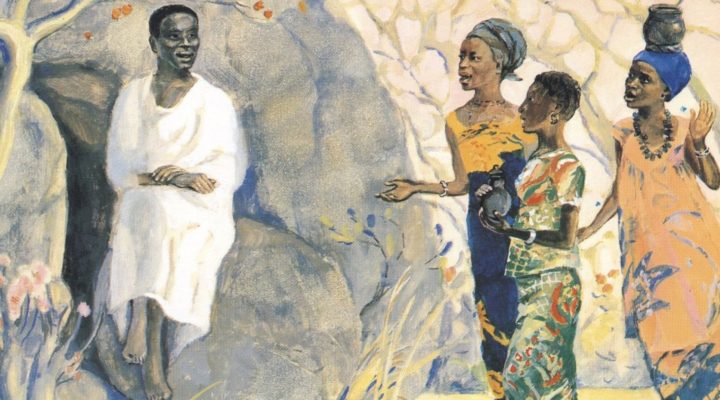
There is a quiet contradiction in America, one that lives in our homes, our churches, our calendars and our consumer habits. It is the reality that the most theologically powerful moment in Christianity — the resurrection of Jesus Christ — often receives less cultural reverence than his birth.
In a nation where nine in 10 Americans celebrate Christmas, where lights flood neighborhoods, gifts overflow beneath trees and entire economies bend around Dec. 25, we must ask a sobering question: Have we elevated the cradle over the Cross — and more dangerously, over the empty tomb?
Research reveals a fascinating paradox. While Christmas dominates culturally, Easter still holds deep spiritual significance, yet it is misunderstood and underemphasized.

Edmond W. Davis
A Barna Group study found while 67% of Americans associate Easter with a religious meaning, only 42% specifically identify it with the resurrection of Jesus Christ. Even more startling, only about 2% of Americans consider Easter the most important holiday of their faith.
Yet, for centuries of Christian doctrine, Easter is not just important, it is essential. Without the Resurrection, there is no Christianity. The Apostle Paul makes this abundantly clear in 1 Corinthians 15:14 — “And if Christ be not risen, then is our preaching vain, and your faith is also vain.”
Even modern behavioral data reinforces Easter’s spiritual pull. According to Pew Research Center, Americans search for “church” more around Easter than any other time of the year — even more than Christmas. And about 62% of U.S. Christians say they typically attend church on Easter Sunday.
So spiritually, Easter still moves people. But culturally, it lags far behind.
Christmas has undergone what historians would call a “cultural reinvention.” Once a strictly religious observance, it has evolved into a universal, commercial and emotional holiday — complete with Santa Claus, gift exchanges and global marketing dominance.
In fact, 90% of Americans celebrate Christmas, but fewer than half emphasize its religious meaning. Among younger generations, the trend is even clearer — many view Christmas as more cultural than spiritual.
“Spiritually, Easter still moves people. But culturally, it lags far behind.”
Easter, on the other hand, has resisted that transformation.
It has not been commercialized to the same extent. It has not been rebranded into mass entertainment. And because its message is heavier — death, sacrifice, resurrection — it has remained more theological than marketable.
But here’s the problem: What we commercialize, we normalize. What we normalize, we prioritize.
And America has clearly prioritized Christmas.
Scripture does not center the faith on Bethlehem; it centers it on the Resurrection. The birth of Christ is miraculous. But his resurrection is victorious. The birth announces God with us. The Resurrection declares death defeated.
Without the Resurrection, there is no salvation, no victory over sin, no eternal hope. This is not theological opinion; this is doctrinal foundation.
We are living in a time where religious identity in America is shifting. Weekly church attendance has dropped to around 30% nationwide, and the number of religiously unaffiliated Americans continues to rise.
Yet paradoxically, moments like Easter still draw people back. Pastors report 90% of churches experience their highest or near-highest attendance on Easter Sunday.
Why? Because deep down, even in a secularizing culture, the Resurrection still resonates.
“America celebrates what it consumes, but it reveres what it understands.”
It speaks to hope in suffering, life after death, redemption beyond failure.
As a social historian, I see patterns. And the pattern here is clear: America celebrates what it consumes, but it reveres what it understands.
We have taught generations to celebrate Christmas. But we have not equally taught them to understand Easter. And that is a dangerous imbalance.
When the Resurrection loses its centrality, Christianity becomes cultural instead of transformational.
This is not an argument against Christmas. Christmas matters. The Incarnation matters. But what I am calling for — what we must demand — is balance rooted in truth.
Imagine if Easter weekend received the same national buildup as Christmas, if Resurrection Sunday carried the same anticipation as Christmas morning, if families prepared spiritually for Easter with the same intensity they prepare materially for Christmas
That would not just change holidays. That would change hearts. That would change homes. That would change America.
The empty tomb is not a side note in Christianity; it is the headline.
Edmond W. Davis is an American social historian, international speaker and Amazon No. 1 bestselling author. He is a global authority on the Tuskegee Airmen and serves as the founder of the National HBCU Black Wall Street Career Fest. A native of Philadelphia and current resident of Little Rock, Davis is committed to cultural empowerment and educational equity through storytelling and civic engagement.