

The Supreme Court’s major rulings this June and early July may collectively be remembered as one of the most constructive political developments of this momentous and terrible year.
 The court’s decisions this term gave important wins and losses to both liberals and conservatives, were voted on by surprising alliances of judges, and were rarely resolved by 5-4 bloc voting. (One brand-new exception was the awful 5-4 vote to allow a federal execution to go forward in the wee hours of Tuesday morning, July 14.) They also set limits on President Trump’s claims of power while not positioning the judicial branch to decide the November presidential election.
Taken together, the court’s body of work during its regular term helped hold our fragile democracy together during a time of high social stress. That is no small achievement.
For almost 50 years, amid the bitter conflicts of a culture in profound religious and moral transition, the Supreme Court has evolved to become the decision-maker of last resort on the most controversial moral-political issues facing our desperately divided country: abortion, sexuality, church/state relations, race, immigration, contraception and so on.
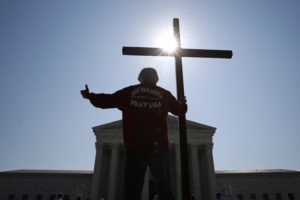
Tom Alexander holds a cross as he prays prior to rulings outside the Supreme Court on Capitol Hill in Washington, Wednesday, July 8, 2020. (AP Photo/Patrick Semansky)
Through nine presidencies, the United States has descended into a deadlocked, morally divided, red/blue society. Congress (especially when controlled by opposite parties) has proved ineffectual in offering legislative solutions. Presidents have turned more and more to executive orders easily overturned at the next election. Mass media has become balkanized.
In this context, finding even semi-permanent, regular-order policy solutions to basic governance problems often has ended up in the hands of the judiciary and especially the Supreme Court. This has been quite a burden for the court to bear, and such a circumstance could hardly have been imagined by the American Founders.
By now the Supreme Court itself has become symbolic both of our national fragility and, at times, of what hope might remain for our democratic survival. Nine very different judges, appointed through a highly charged political process, increasingly expected to be the bearers of victory for our side (you know: the right side, the virtuous side, the just side), must sit in a room together all year long and talk to each other. Then they must finally resolve their major cases in such a way that both American sides feel that they were treated fairly overall — and that both still have a stake in America.
“The Supreme Court itself has become symbolic … of our national fragility.”
Indeed, it has come down to nothing less than that. The most ardent ideological warriors on both sides fear that their country is at risk of becoming enemy territory, where our side is not at home, our basic values are threatened with extinction. Sometimes it seems that with each Supreme Court term, the question of whether two disparate groups of 50 million Americans will believe themselves to still belong here is up for grabs. If the court were to fail repeatedly and visibly in offering hope to the partisans of either side, it could be the final spark leading to mass emigration, violence or even civil war. I do not believe I am exaggerating.
This may be a good time to note that as of 2020 American religion offers little help in knitting our fragile nation together across its culture-wars divisions. As most readers will know, we see Red Religion and Blue Religion around us every day. Christianity as such does not seem to exist anymore. Instead, we have Red and Blue Christianities. In this sense, one of the most significant political contributions of our churches occurs precisely when we hold red and blue peaceably together in purple congregations.
From the beginning, at least for his opponents, the potential presidency of Donald Trump raised the risks of pushing our red/blue divisions to the breaking point, including through his approach to the Supreme Court. While running for president, Trump promised to appoint true-red, conservative-approved jurists off a list outsourced to the Federalist Society. He raised the hope of conservatives that he could essentially guarantee them their cherished policy wins.
Trump may not have known that much about politics in 2015, but he did know this: religious (and other) conservatives would swallow an awful lot if he would deliver them their preferred judges. There was reason to expect lockstep 5-4 conservative wins, on everything, after the confirmation of Brett Kavanaugh in 2018.
Of course, Democratic presidential candidates also have made and delivered upon specific promises about what kind of Supreme Court justices they would appoint. They usually have been a bit more subtle about it.
Once it became likely that the Supreme Court was ultimately going to have to rule on actions and litigation involving Trump himself, the stakes became that much higher. Trump’s opponents had every reason to wonder whether a firmly conservative-majority Supreme Court would be willing to cross the president in cases involving himself. And challenges to the rule of law, the integrity of the Department of Justice, and the independence of the judiciary overall have deepened since William Barr began his distressing run as attorney general.
So now it’s the 2019-2020 term, and you are Chief Justice John Roberts. How do you handle this year’s cases? You might conclude that it is important to position the court as neither partisan nor supine before executive power. You might want to offer some decisions that go to the left and others to the right. You might want as few 5-4 votes as possible. You might want unpredictable people writing certain decisions and unpredictable voting alliances whenever possible.
And you might want to signal that the court will be unintimidated on decisions involving the president himself.
Now, of course, I have no idea if Chief Justice Roberts or any other justices were thinking in those terms this year. But I am quite sure that the work that they offered conforms almost exactly to the pattern I just suggested.
A quick review:
Religious conservatives won three church-state cases. Little Sisters of the Poor v. Pennsylvania and Our Lady of Guadalupe School v. Morrissey-Berru were decided on surprisingly robust 7-2 votes, in which liberal judges Elena Kagan and Stephen Breyer crossed over. Conservatives also won Espinoza v. Montana Department of Revenue, on a more predictable 5-4 vote. The first case will help to cement federally guaranteed opt-out rights based on religious and moral convictions; the second interprets the First Amendment’s religion clauses as restraining state involvement in religious-institution hiring practices, and the third case advances access to state funding for private-religious-schools on the same basis as private secular schools.
These were big wins for religious conservatives. Bracketing discussion of their legal merits, these decisions should help religious conservatives feel that at the Supreme Court they can sometimes find safe harbor.
On the other hand, social-justice liberals can be said to have won on four fronts. Department of Homeland Security v. Regents of the University of California has for now protected Deferred Action for Childhood Arrivals recipients from deportation. Three cases involving gay and transgender rights were decided to establish a historic national ban on LGBTQ employment discrimination based on the 1964 Civil Rights Act (with the decision written by Justice Neil Gorsuch, appointed by Donald Trump). June Medical Services v. Russo ruled Louisiana’s highly restrictive abortion law just as unconstitutional as the Texas statute which it imitated. McGirt v. Oklahoma ruled that about half the state of Oklahoma belongs to the Creek Nation (with Justice Gorsuch again siding with the court’s liberal bloc). Conservative justices Roberts and Gorsuch crossing over on some of these cases is just as important as their content.
Finally, on the last day of its term, the Court dealt with two Trump cases (Trump v. Mazars and Trump v. Vance). In complex 7-2 votes (including Roberts, Gorsuch and Brett Kavanaugh siding with the four liberal justices) the court established the principle that the president is not above the law at either the state or federal level, while ruling more favorably on the New York State case against the president than on the claims from the Democratic House of Representatives. Still, in both cases, further legal action seems likely to be delayed until after the November election. These were positively Solomonic outcomes.
The election is coming in less than four months. Partisans will still point to Supreme Court appointees as among the main reasons to vote for their guy for president. But the idea that the court is not just a partisan tool, that it operates according to the rule of law, and that specific Supreme Court justices will think independently, survives.
In a year full of sheer awfulness, this is rare good news, indeed.
David P. Gushee is Distinguished University Professor of Christian Ethics and Director of the Center for Theology and Public Life at Mercer University. He is the past president of both the American Academy of Religion and Society of Christian Ethics. He is an author or editor of 25 books. His most recognized works include Righteous Gentiles of the Holocaust, Kingdom Ethics, The Sacredness of Human Life, and Changing Our Mind. He earned the Ph.D. from Union Seminary. He and his wife, Jeanie, live in Atlanta.