

What if United Methodists faced a potential conflict and nobody cared?
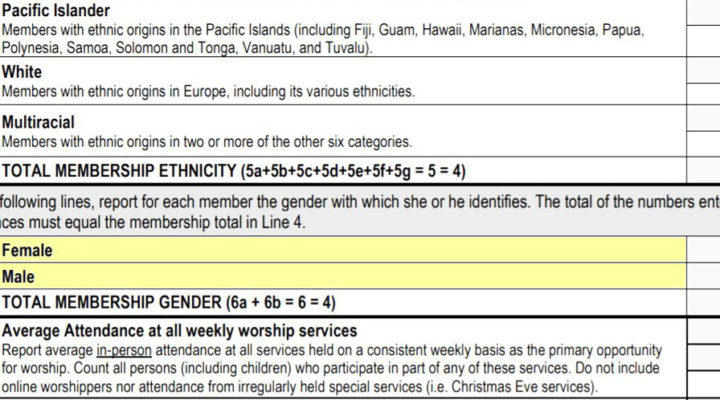
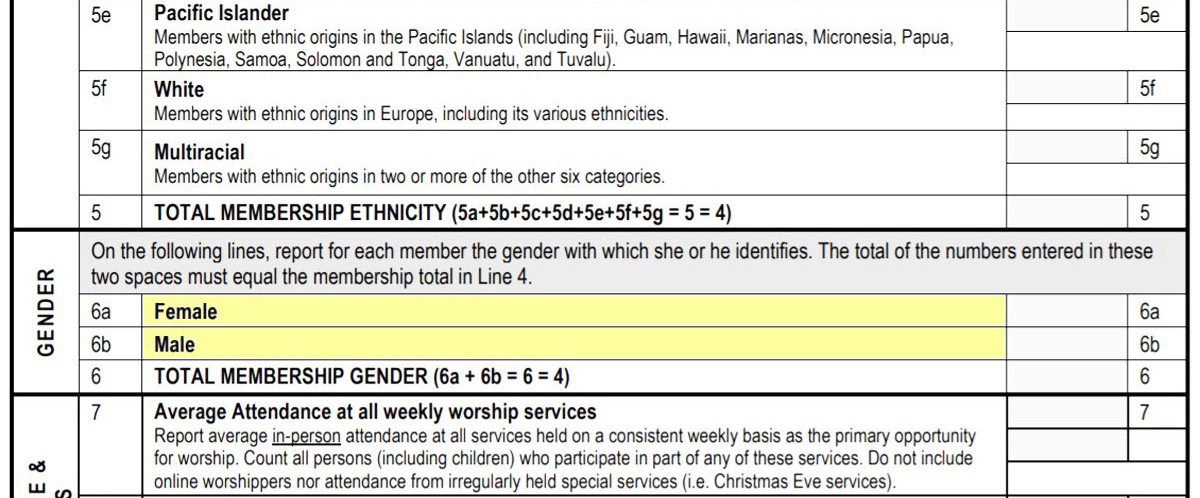
That seems to be the case with a new “non-binary” category for local church membership reports. Something that would have caused massive fireworks in the past has been announced with little fanfare and even less reaction from the denomination’s political caucuses. Observers are non-plussed over the apparent lack of concern after decades of fighting over every jot and tittle of anything related to LGBTQ matters in United Methodist law and doctrine.
The presenting issue came at the June meeting of the General Council on Finance and Administration. GCFA, as it’s known, is the official keeper of United Methodist statistics. Its board of directors approved with one objecting vote adding a “non-binary” category to the annual reports required of every local congregation in the United States. Those reports from 31,000 U.S. congregations make up an annual document known as the General Minutes.
Reports are also required from regions outside the United States where United Methodism is located, but the “central conferences,” as those regions are known, aren’t required to file reports from each congregation — in part because in regions such as Africa and the Philippines, getting a count of local members is sketchy at best.
1.2 million U.S. LGBTQ adults identify as non-binary.
In the United States, “non-binary” commonly describes people whose gender identity falls outside the male-female dichotomy. A June study by the Williams Institute at the UCLA School of Law found that 1.2 million U.S. LGBTQ adults identify as non-binary, according to a recent article by Heather Hahn of UM News.
GCFA directors and staff told Hahn that the “non-binary” category was added at the urging of an unspecified number of U.S. pastors.
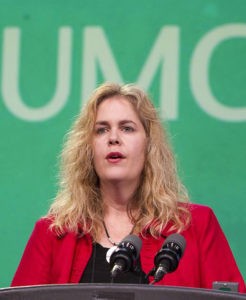
Christine Dodson (UMC News)
Christine Dodson, North Carolina Conference treasurer and the GCFA board’s vice president, said: “We are having issues reporting people, with pastors calling our office and saying, ‘What do I do here?’ Quite frankly, I’ve had a pastor tell me, ‘I’m not going to force a person to choose one or the other when they have told me how they identify.’”
Sharon Dean, GCFA communications director, also told UM News: “We’ve also heard from around the connection that some annual conferences and some other organizations are already using a third choice. And so to be consistent with requests that come in, we might include this additional selection.”
As recently as two years ago, adding a non-binary category to local church reporting forms seemed sure to spark a firestorm of controversy across United Methodism. In 2019 the UMC’s top legislative body, the General Conference, voted to tighten church restrictions against same-sex marriage and ordained LGBTQ people as clergy. The decisions caused a full-scale rebellion in the United States, where nearly three-fourths of annual conferences expressed disapproval of the tightened restrictions, which carry heavy penalties for their violation.
Fast-forward to 2021 and the addition of the non-binary category. Instead of an outcry, representatives of opposing factions have met the development with indifference or mild pleasure.

Walter Fenton
Walter Fenton, vice president for development for the traditionalist Wesleyan Covenant Association, said his organization views askance many UMC developments these days, since the WCA plans to start its own denomination, the Global Methodist Church, as soon as a United Methodist split is formalized by General Conference. The WCA is a major promoter of the negotiated settlement known as the Protocol of Reconciliation & Grace Through Separation, which among other things would provide any new traditionalist Methodist denomination with $25 million in “seed money” over a four-year period.
“I’ve not heard or seen many traditionalists riled up by GCFA’s vote to include a ‘non-binary’ line on the local church stat form,” Fenton said. “And I’m not surprised, because traditionalists do not see themselves being connected to the UMC’s GCFA in the future. With our articles, podcasts, Zoom meetings, regional chapter meetings, and our Global Gatherings, we have made it abundantly clear to our members, friends and other interested parties that the WCA’s focus is on helping traditionalist churches navigate toward the GMC if they choose.”
At the other end of the UMC political spectrum, spokespersons for Reconciling Ministries Network said that they, too, are focusing on a future for The United Methodist Church, but a version that emphasizes broad inclusivity. Hence the addition of a “non-binary” category to local-church reporting forms brings a welcome change but is seen as part of an evolution in LGBTQ acceptance rather than a revolutionary action. RMN also supports the Protocol, which its representatives helped negotiate.
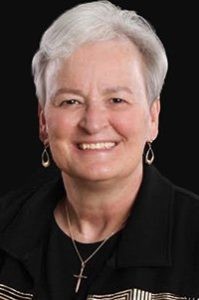
Jan Lawrence
Jan Lawrence, RMN’s executive director who participated in Protocol talks, said: “RMN remains committed to our work toward a UMC that is justice-oriented, antiracist and inclusive. We are not singly focused on the legislative work for the General Conference but are also committed to showing up when needed with others doing justice work in the UMC, and to developing better resources for individuals and congregations who are on the journey to inclusion.”
Ophelia Hu Kinney, RMN’s communications director, amplified the organization’s viewpoint at Lawrence’s request.
“At RMN, we’re grateful for the persistent advocacy of non-binary people and their loved ones for making it possible that our church records might better reflect our church’s people,” Kinney said. “While this change does not reflect a transformation of the harm done by the institution against LGBTQ persons, it does model inclusivity in language. Our hope is that talking and reporting about non-binary people in our pews and leadership may provoke changes in the institution’s policies toward non-binary and other LGBTQ people, too.”
Whether the new “non-binary” category on local-church reports offers another straw in the wind toward a United Methodist break-up remains to be seen. Reporting the genders of church members with other than male or female identity acknowledges both the church’s recognition that non-binary persons exist and that they’re among United Methodist members.
For traditionalists, the mere fact of that acknowledgement contradicts the biblical norm of “male and female God created them,” and thus strays far afield from Christian faithfulness. Alternatively, progressives who’ve spent decades campaigning for full inclusion of LGBTQ persons find the non-binary category a happy signpost on the path toward the United Methodist Church’s future.
Cynthia B. Astle is a veteran journalist who has covered the worldwide United Methodist Church at all levels for more than 30 years. She serves as editor of United Methodist Insight, an online journal she founded in 2011.
Related articles:
Now there appear to be three paths for once-united Methodists
Top-down schism plans ignore local United Methodist churches’ new reality