

By Greg Warner
What possible connection could a real estate banker from Alabama have with a chicken farmer in Uganda? As it turns out, quite a lot.
Lee Surtees was making a good living in banking, finance and real estate while raising a family in Birmingham, Ala. But what he really longed for, he said, was to be involved in something more “eternal.” So when his longtime friend Jade Acker, one of the Cooperative Baptist Fellowship’s field personnel working in Uganda, called with an unusual proposal—to invest money in refugee-entrepreneurs—Surtees jumped at the chance. “I had been praying for some time how I could use my business skills in a more missional capacity,” recalled Surtees.
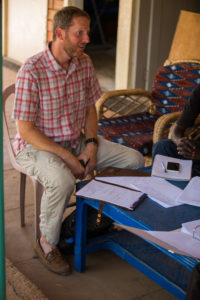
Lee Surtees, a Birmingham, Ala-based layperson working in real estate and finance, partnered with CBF field personnel Jade and Shelah Acker to invest in refugee entrepreneurs in Uganda.
Acker had just the right match—a mock Shark Tank connecting U.S. investors with potential businesses operated by refugees. Jade Acker and his wife, Shelah, are founding directors of Refuge and Hope, a multifaceted ministry for refugees who come to Uganda seeking safety and opportunity.
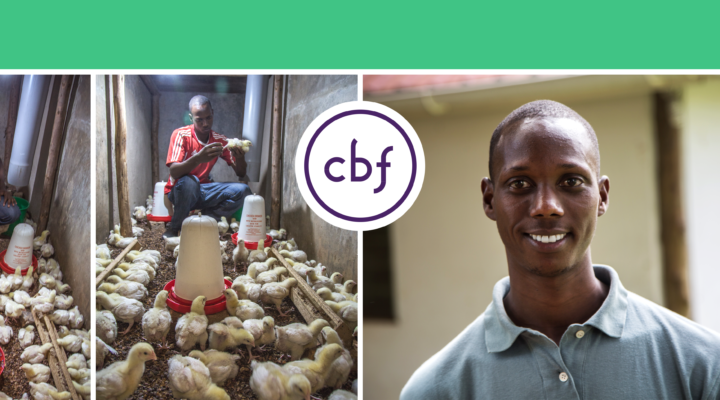
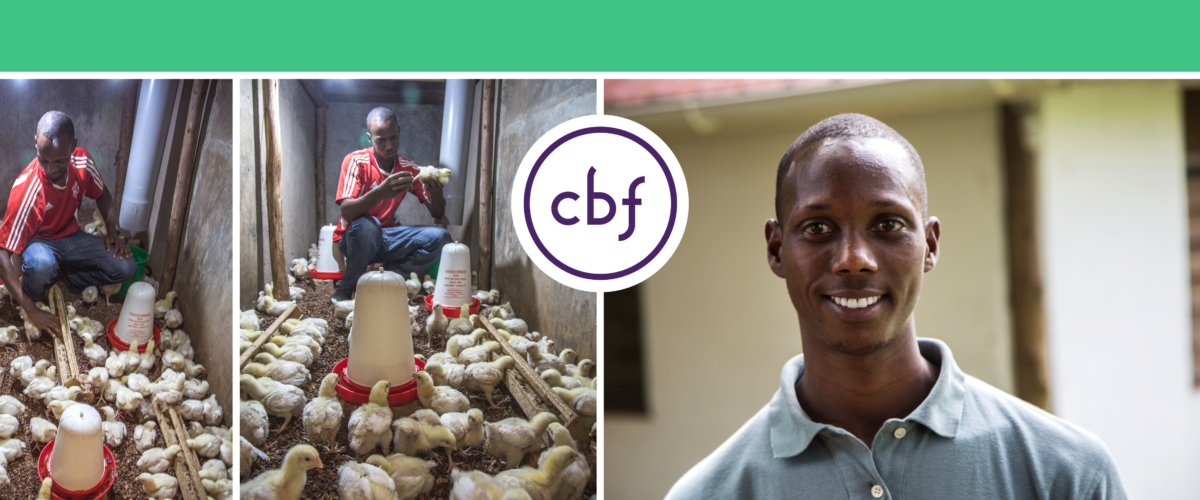
“They said that whoever can come up with a good idea for business, [they] can fund them,” remembered Arcade G’Bukman, a refugee from Burundi living in Kampala, the Ugandan capital. “I came up with a business [of] poultry farming.” Arcade had never raised chickens before. But he’s a hard worker who has a knack for math and a good business plan. And not one to aim low, Arcade also plans to be president of Burundi some day.
What he knows about chickens he learned by watching his landlady. “She was rearing chickens and my younger brother was taking care of them,” he explained. “I had learned a lot.”
Arcade was one of 40 entrepreneurs, mostly refugees, who made their pitch to potential investors.
“From those 40 different pitches,” Acker said, “we chose five businesses to invest in,” based on the owners’ business plans, reputations and readiness.
The plan is a win-win-win.
“We’re training and equipping refugees and other local people in how to do business better,” said Acker, also from Birmingham. Then, with money raised from investors like Surtees, Refuge and Hope becomes a business partner with the entrepreneur, splitting the cost of the start-up and the eventual profits— usually 50-50.
“And when we turn a profit in those businesses,” Surtees added, “those profits will come back to support the ministry center and the work that’s going on here at Refuge and Hope.”
The purpose is sustainability—to sustain the business, the livelihood of the owner, the economy of the surrounding community and, ultimately, the ministry of Refuge and Hope.
On a visit to the U.S., Acker attended a class on social entrepreneurship, and then happened to watch the long-running ABC reality show Shark Tank, in which hopeful entrepreneurs pitch their business plans to a panel of high-powered investors who decide whether or not to buy in. “My mind began spinning,” he recalled. “What if we had a Shark Tank in Uganda?”
He recruited three friends, all businessmen in the U.S., who put up the money. They flew to Kampala for a week early last year to hear business pitches from 40 hopefuls—and to pick five winners.
Arcade G’Bukman’s poultry business wasn’t one of them. The “sharks” determined he wasn’t quite ready. But they were definitely impressed. “Everyone around Arcade recognizes that he is geared for bigger and better things,” Surtees said, “and people just want to be a part of the process to help him get there.”
They recommended he take a class at Refuge and Hope to improve his business skills and start saving money. He took the course, saved his money and opened a bank account. But it still wasn’t enough.
He shared his plan—and frustrations —with people at Refuge and Hope, including a group of teachers. “I shared with them and they funded my business. I was able to start.”
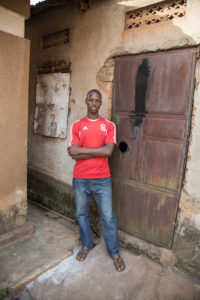
Arcade G’Bukman, a refugee and student from Burundi living in Kampala, Uganda, receiving training from CBF field personnel at Refuge and Hope International on entrepreneurship and started a poultry business.
At least four of the first five partnerships have now come online. Most aren’t producing much profit yet, but Acker is hopeful.
- Siimba Shield Security Force—Burglary is a serious problem in Kampala, requiring homes and businesses of any size to have security. “You have day guards; you have night guards; you have 24-hour security,” Acker explained. Siimba Shield’s first customer was its partner, Refuge and Hope. It now has about 14 guards serving 10 clients around the city, and is going through the city’s licensing process.
- Hope Landscaping—a grass-cutting company, which in Uganda means weed-eaters, not mowers.
- A soybean-and-eggplant farm.
These businesses not only provide a livelihood for the partners, they meet another need by often hiring students from Refuge and Hope. Even after they learn English, computer skills and business skills, refugees still struggle to find jobs in Kampala, where as many as a third of young adults are unemployed.
Two other businesses, while not partnerships, provide training and jobs for refugees and income for Refuge and Hope. Sewing Hope teaches sewing skills and sells its clothing in the community. Taste of Hope, a food service and catering company, operates the canteen on the ministry campus and catering services off-campus.
After Shark Tank, Surtees went home to Birmingham—but not for long. He was hooked.
“After being here for a week, and picking several businesses that we wanted to invest in, I just felt like I wanted to spend a significant portion of my time in this activity and helping to grow these businesses,” the banker said. “I was just really touched by that activity.”
“That’s when my wife and I decided to move our family to Kampala for at least a year in support of those businesses and in working with Refuge and Hope,” he said. “I actually quit my job—I don’t have a job to go back to.”
“We, for several years now, have felt a greater and greater call towards missions,” he said. “Just to be honest, at one point in time I was like, ‘My job is interfering with my ability to do missions.’”
He now co-directs the sustainability program along with Mujulizi Gilbert, a Ugandan trained in entrepreneurship and project management. They serve as management consultants to the business partners, while teaching classes in business, entrepreneurship and other topics at Refuge and Hope.
The Surteeses emphasized the importance of exposing their school-aged children to new people and cultures. “If you know culture and Christianity only from an affluent suburb in the United States, you’re really not getting the full picture on what the global church looks like,” he said. Already the experience has opened up his understanding of God, he said.
“How people experience God is much different in different cultures,” he said. “More of God is revealed to you when you see God and God’s interaction in other people.”
Lee Surtees also believes in the strategy of social entrepreneurship and other ways Refuge and Hope is changing lives for eternity, he said. “I really enjoyed my career, and I may go back to it; but those things don’t seem eternal like the work that’s being done here,” Surtees said. “The impact on people’s lives from a spiritual level … will last for ever and ever and ever.”
Social entrepreneurship is a hot topic on the mission field today, as funding gets ever tighter and strategies focus more on sustainable development—on projects that grow organically and which can sustain and replicate themselves without long-term outside subsidy or involvement. Such strategies include micro-loans, self-help groups, “tentmaker” programs, community-invested development, and business as mission.
Some mission organizations operate businesses to help fund their ministries—or business as mission, Acker and Surtees explained. Others help residents start businesses to support themselves—mission as business. The sustainability program at Refuge and Hope “married the two together,” Acker said.
“It’s not business as mission as much as it is business for mission,” agreed Surtees.
Arcade is a success story for sustainability, Acker and Surtees agree, even though he didn’t attract the sharks’ attention.
In addition to raising chickens, Arcade teaches pre-GED classes. After studying entrepreneurship, Arcade finished the GED program at Refuge and Hope, a prerequisite to entering university. His story demonstrates the transformative power of social enterprise, Surtees suggested. With the income from his two jobs, Arcade “can support his educational opportunities, his business opportunities, provide for himself, and go on to bigger and better things.”
Likeable, friendly and ambitious, Arcade is the kind of person everyone roots for, Surtees
said. “I think we met him the first day or two that we were here and we were like, ‘That young man is about the nicest person we’ve met.’”
“In everything he does, he strives for excellence,” Acker added. “It’s amazing how he tries to make himself professional in all he does. And he really gives it 100 percent. I perceive that he’s going to … have a great future, be a leader.”
Such lofty expectations don’t often fit people of Arcade’s background: A family broken apart by war, driven into exile, and beaten down by poverty; a homeland, one of the poorest countries in the world, with a tragic past and pessimistic future.
Burundi has been consumed with violence or political turmoil since gaining its independence in 1962. Like Rwanda to the north, Burundi was torn apart by the Hutu-Tutsi genocide of 1994, triggering international outrage. Paradoxically, Burundi is both overwhelmingly rural and dangerously overpopulated. While 87 percent of people live in rural settings, Burundi is one of the most densely populated countries in Africa. It’s as if the whole population of Pennsylvania lived in the villages of Vermont.
Amid Burundi’s roiling political turmoil, police officers and other government employees often became targets. Arcade’s father was one of those—a soldier who got crossways with the government.
“They attacked us twice,” Arcade said.
Leaving their mother and sisters behind in Burundi, the father took Arcade and his younger brother to Rwanda. But when his father couldn’t find work, he and his younger brother were sent to live with an older brother, who it seemed had found a stable life in Kampala. Life in Uganda was little better. His brother had a problem with alcohol, Arcade said, leaving no money for food, much less for school fees. In Uganda, as in many African countries, public education isn’t free.
“At the time I came here, I didn’t even know a single word in English,” he said. For refugees, learning English is the key to adapting in Uganda, where two official languages are recognized—English and Luganda.
But Arcade heard about an organization that teaches English to refugees—Refuge and Hope. Arcade learned English quickly. By nature a competitive person, “I became determined to always be the first person,” he said.
But learning English was just a start—he had to get back into high school and get his diploma. “You cannot think about university if you haven’t finished secondary school,” he said.
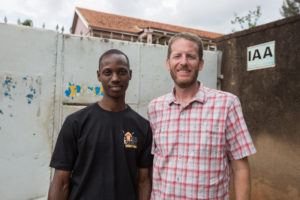
Arcade G’Bukman and Lee Surtees
So it was good news when Refuge and Hope announced it was starting a GED program—for a general equivalency diploma—which universities in Uganda accept for admission.
Arcade ended up studying in the GED program and working at Refuge and Hope. If he makes it to university, he plans to study public relations. He might work in government, be an ambassador, or maybe become a lawyer, he said. “I love talking to people.”
“I want people to have equal rights,” he said. “That is one of my main goals that I want to do in my life.”
When he participated in the youth department at Refuge and Hope, “they used to teach us that one person can change the whole nation,” Arcade recalled. “I became determined to change a nation,” he said, referring to his homeland of Burundi.
He has taken on a daunting challenge. One of the poorest countries in the world, Burundi has been left spoiled by two civil wars, unspeakable ethnic genocides and constant political turmoil.
“It may not work as I want it to, or be achieved on time,” he qualified. “But that is one of my highest goals. I want to be a president.”
“Refuge and Hope [also] has taught us to have a good love for other people,” he said. “I always ask God to create an unshakeable source of love in my heart. I love people a lot, and this is how I want to change people’s lives.”
This work is made possible by gifts to the CBF Offering for Global Missions. Your gift will plant churches/provide skills and opportunities for others and share the love of Jesus with people who have been forgotten by society. Please make your life-changing gift at www.cbf.net/give. You can help change the world one person at a time.