

By Ken Camp
During the five years she served as his caregiver, Sue Strother and her husband, Joe, understood the roles each filled. “He bore the pain. I bore the strain,” she said.
Her husband, pastor of North Riverside Baptist Church in Newport News, Va., was diagnosed with multiple myeloma—cancer of the blood plasma cells—in 1989. His wife cared for him through rounds of chemotherapy, a period of remission and recurrence of the cancer.
“He had the cancer, but it affected both of us,” she said.
The couple tried to “keep it as normal as possible,” she recalled. For three years of his illness, he continued to preach, meet other pastors one morning a week at a restaurant for breakfast, receive visitors at home and record taped messages for broadcast on radio. She used those occasions when he was with visitors to run errands and have some brief respite, but she struggled with anxiety.
“I tried not to worry about him, but it was hard to break away. Those were the days when cell phones were not common, and I found myself wondering about him and always was pretty anxious about getting back,” she acknowledged.
Mrs. Strother felt grateful for the time they had together after her husband’s initial diagnosis, and she recalled, “We laughed a lot.”
But she also remembered other feelings.
“I was angry a lot of the time. Never at God—I couldn’t have made it without him. But Joe and I got mad at each other sometimes,” she said. “And I felt anger directed at the cancer, at the situation, and at knowing I was losing my life’s partner and soul mate.”
Part of the anger she and her husband sometimes felt toward each other grew out of their changing roles.
“He felt like my patient and not my partner,” Mrs. Strother said. She, on the other hand, wrestled with dual roles—partner in their long and loving marriage, but also caregiver to a person who needed 24-hour attention.
As her husband’s condition grew worse, she particularly struggled with guilt.
“I felt guilty about things I felt, or things I said, or things I didn’t say. There were days I was impatient. There were times Joe would call for me and I just couldn’t answer. I was so tired, and I felt like I couldn’t do anymore. And then I felt guilty for thinking that,” she said. “I loved and adored him. I would ask myself, ‘What is wrong with you?’”
Because of her husband’s public position as pastor, she often received early morning visits and late-night calls from church members asking about his status. While she appreciated the expressions of concern, she said, “I resented the intrusion.”
Early in his illness, Mrs. Strother and her husband pledged to be honest with each other in expressing their emotions. But as his illness progressed, “Sometimes I felt I needed to be strong for him.”
 Fortunately, she found friends in whom she could confide. A local Presbyterian minister and his wife became trusted confidantes. A small group of friends also occasionally took her on a getaway to Williamsburg and gave her a treasured gift—listening without judging.
“They would let me say anything to them,” she recalled.
Early in her husband’s illness, Mrs. Strother looked for Christian books on caregiving to help her understand and cope with what she and her husband faced, but most of what she read was too saccharine for her tastes.
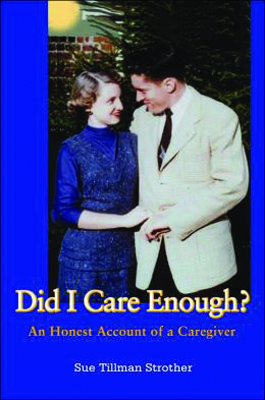
So, several years later, she wrote a book about her experiences—Did I Care Enough? An Honest Account of a Caregiver. It included her testimony of God’s sustaining grace, but it also presented a candid account of the wide range of emotions with which she wrestled.
“Caregiving is a mix of love, devotion, faith, laughter, anger, fear and frustration,” she wrote.
Mrs. Strother emphasized her book offered simply an honest description of her own experience, not a prescription for how anyone else should feel or respond. However, she did learn a few lessons learned that she considers universal:
— “Don’t say, ‘I know how you feel.’ You don’t. Nobody knows how anybody else feels, because any situation is going to be unique.”
— “Sometimes there are no words. When there aren’t, don’t try to hunt up a little sermonette.”
— “When you want to visit, call first. … Honestly, most of the time we visit people at our convenience—not theirs.”
— “Let people say how they feel, and don’t judge them.”
— “God understands.”
Related New Voice feature: