


Environmentalist Bill McKibben considers himself a big fan of “Brother Sun,” as his ecological spiritual ancestor, Saint Francis, termed earth’s star in his famous canticle.
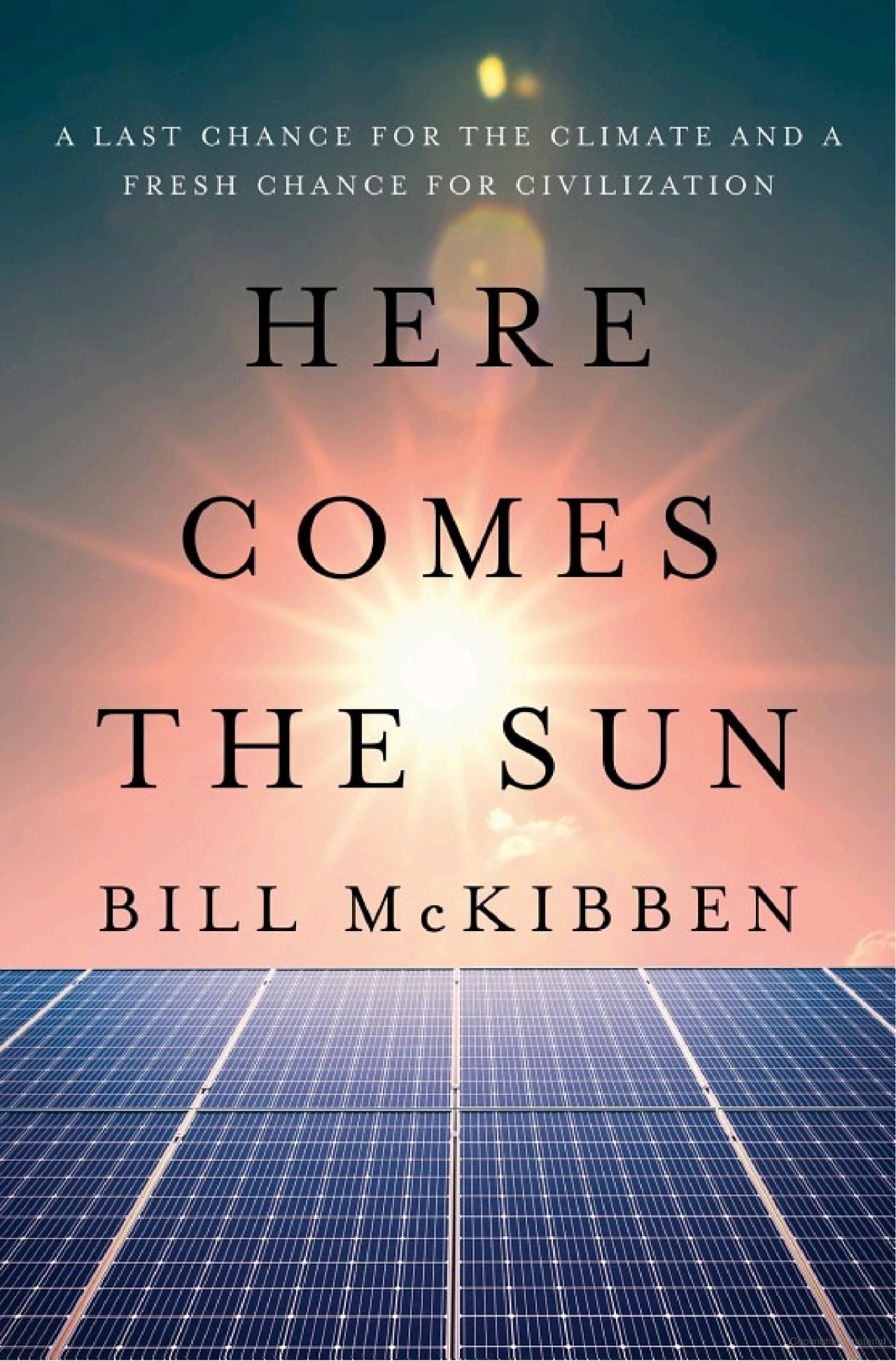
Often considered the godfather of the contemporary environmental movement, McKibben’s new book, Here Comes the Sun, argues solar power is no longer an “alternative fuel” but has outpaced fossil fuels as the cheapest and most efficient way to generate power for humanity’s needs.
The key now, he says, is to propel the rising solar power movement forward despite massive resistance from the fossil-fuel industry and its political enablers.

Bill McKibben
In a recent interview, McKibben spoke about the new book and the coming Sun Day observance, scheduled on the autumnal equinox Sept. 21 to promote the transition to solar and wind power from fossil fuels.
Cynthia Astle: I was bowled over by all you describe in the book, the facts and figures about the rise of solar and wind power in terms of manufacturing and efficiency. How do you keep track of all of that?
Bill McKibben: I think your reaction is the reaction of most people, including many who think of themselves as environmentalists. We’ve stuck this kind of energy in a place in our heads that we’ve labeled “alternative energy” for 40 years now, and I think it was very hard for people to realize that it had broken out of that and become the most obvious mainstream.
The analogy I keep using is we’re used to thinking of it as the Whole Foods of energy, when in fact, it’s now the Costco of energy. It’s cheap, it’s available in bulk, it’s on the shelf now.
A couple of years ago, I noticed an acceleration, almost mind-bending acceleration, in the pace at which (solar power) was happening. Sometime about five years ago we crossed some invisible line, when it became cheaper to generate power from the sun and the wind than from burning coal and gas and oil.
“Sometime about five years ago we crossed some invisible line, when it became cheaper to generate power from the sun and the wind than from burning coal and gas and oil.”
That was a very epochal moment for human civilization. I mean, it allows us to imagine ending the long-running human practice of combustion and replacing it with power directly from the sun. But it’s such a big change that I think it’s hard for us to completely wrap our minds around. It’s much easier if you’re out traveling in the rest of the world, especially if you’ve had the chance to be in China in recent years where it’s obvious what’s going on. But truthfully, the same thing is true in California in the past 18 months. It’s true in the Lone Star state where the acceleration of sun, wind and battery power is now the defining feature of energy across that region.
Astle: That’s all been impressive on the macroeconomic scale, but for some folks, including a lot of church folks, the upfront cost of getting (solar) panels on your roof is still almost prohibitive.
McKibben: This was the problem (President Joe) Biden was addressing with the IRA (Inflation Reduction Act) and now (President Donald) Trump has repealed the IRA. If you want to access the federal 30% tax credit, you need to install your solar system before midnight on New Year’s Eve. And if you want to access the federal tax credits for electric vehicles, you need to buy them before the end of September.
These were programs designed to last 10 years and to help America catch up with the rest of the world on (solar power). But at least for the moment our government has decided not to do that. So now with Washington not helping, we need to figure out other ways to keep bringing the cost down.
In America, it costs about three times as much to put up solar panels as it does in Australia or the EU. This is not because the panels cost more, although with tariffs that’ll be a little part of the problem. It costs much more because we have these excessive permitting requirements unlike any others in the world.
“It shouldn’t be much harder to get a solar panel on your roof than it should be to put a new refrigerator in your kitchen.”
America has about 15,000 jurisdictions, cities, towns, counties, and they each have their own rules, and they all send out inspectors — which in this case is unnecessary. It shouldn’t be much harder to get a solar panel on your roof than it should be to put a new refrigerator in your kitchen.
If you’re living in Spain or in Australia, you can call up this Wednesday afternoon, order solar panels for your roof, and they’ll be installed and producing power by Monday afternoon. For instance, in Europe in the last few years, there’s been a big surge in what they call balcony solar.
Astle: Yes, I’ve read about that. I’ve seen pictures of those panels. That’s exciting, but we can’t get that here.
McKibben: That’s the thing. It’s illegal in most of this country, completely unnecessarily. But the exception to that is the quite “red” state of Utah where the state legislature this spring unanimously passed enabling legislation because a libertarian state senator said, “Why can you do this in Frankfurt and Hamburg, but not in Salt Lake City and Provo?”
 Nobody had a good answer. So now it’s legal in Utah, and people are (installing balcony solar panels). That’s another thing we’re pushing for because apartment dwellers should have the same ability to take part in this revolution as homeowners.
Astle: How can we faithfully advocate for solar amid all that’s going on to roll back the renewable energy movement?
McKibben: A way of saying this is, if renewable energy was not important, then the fossil fuel industry would not have spent so much time and money making sure they helped win the last election. California, which is the fourth largest economy in the world, now has put up so many solar panels that they’re using 40% less natural gas to produce electricity than they did two years ago. To me, that’s a wonderful statistic. But if you run an oil company, that’s a terrifying statistic; it’s huge.
You may remember about this time last year, presidential candidate Trump told oil executives if they gave him a billion dollars, they could get anything they wanted once he was president. They put up about half a billion between lobbying and campaign donations and advertising last year. That, I guess, is enough because they’re getting everything they wanted.
And the reason why (the fossil-fuel industry is getting so many concessions) is their terror at this dramatic shift in solar power. They know they can’t really compete straight up with clean, cheap, renewable energy; they’re gaming the political system to allow them to.
There was an interesting test of that in your state (Texas) earlier this year.
Astle: I remember that! Farmers and ranchers overwhelmed the legislature (when it tried to slow down solar power installations).
McKibben: That’s right. They all descended on Austin and said, “Do not do this.” That was a very powerful moment. It’s large parts of rural America — I’ve lived my whole life in rural America — that are very much in favor of (solar power) because it’s a great boon to communities to have these projects that produce a lot of tax revenue right close to home.
Astle: In times like this, when we’ve hit this roadblock, do you ever despair?
McKibben: Well, yes, sometimes, but those are moments when having a faith practice is a good thing. I think Christians are allowed to hope that if we do all we can, the world will meet us halfway.
That’s different from just trusting that everything will work out because God will make it so. I do not believe that. I believe we’re called to do all we can.
But yes, it’s a very depressing moment, not only politically, but because we can see the big signs of climate change now at work on the planet. The ways the Gulf Stream and the Jet Stream are now flickering and faltering. The fact that we see what it means to have heated the air so that it can hold more water and produce more flooding. You had a horrible instance of that in the (Texas) Hill Country last month. Those things do depress me and sometimes lead me to despair. But we’re allowed to think that if we do everything we can, there’s some other force in this world that will answer to that.
And I love the idea that sort of in Hollywood fashion, renewable energy is riding to the rescue at exactly the last possible moment. We know from the beginning of the Good Book that one of the first things the Good Lord saw fit to do was hang a large ball of burning gas 93 million miles up in the sky. And he’s given us the wit to learn how to make full use of it, which I love. I mean, energy from heaven, not from hell. That’s my mantra.
Astle: What would you most like people of faith to understand about Sun Day and its implications for the movement?
McKibben: A couple of things.
People around America need to do this work I was describing earlier of making it clear that (solar power) is no longer “alternative energy,” that there’s nothing strange or scary or complicated about it. There’ll be thousands of people opening their homes to their neighbors to show them their solar panels, their heat pumps. There’ll be parades of EVs and e-bikes.
“The advent of clean energy represents the single greatest possibility for rapid development and poverty alleviation we’ve ever seen.”
And I hope we’re able to jumpstart the effort to persuade cities and states to make it much easier to do this work. Washington obviously isn’t going to be much help in the next couple of years. They’ve been captured by the fossil-fuel industry. But that doesn’t mean lots of cities and states can’t do impressive things. So, I’m hopeful we can get a lot of permitting reform and legal changes under way.
Astle: Is there anything we haven’t touched on that you think is important for people to know?
McKibben: One of the things that has always animated a lot of my fellow parishioners and me is a sense of responsibility to the poorest parts of the world.
On the one hand, climate change represents the single greatest threat to the poor world there’s ever been. The toll now of flood and fire and drought is assuming almost impossible dimensions.
On the other hand, the advent of clean energy represents the single greatest possibility for rapid development and poverty alleviation we’ve ever seen. Eighty percent of people in the world live in countries that must import fossil fuel. For those countries, that’s often the reason they’re so far in debt and they can’t afford hospitals and schools.
I was just looking at the numbers for India; they spend the equivalent of 5% of their GDP — 5% of the entire economy — buying oil from overseas. They don’t need it (fossil fuels) because they have plenty of sunshine and plenty of wind. So really the greatest development effort we could ever do, the most powerful way to love one’s neighbor we could put into practice, would be to help them quickly build out the renewable energy capacity they need.
The same thing is true for poor communities and people in this country, but it’s especially obvious when you look at the poorest countries in the world. Remember, there’s almost a billion people on this planet who have no electricity at all right now.
For me, this is probably the single most interesting project Christians can be engaged in right now. The Good Lord was kind enough to hang this big ball of burning gas up there, and it’s a shame that we let it go to waste day after day after day after day. The sun already gives us light; it already gives us warmth. It already allows us to have photosynthesis, and now it’s willing to give us all the power we could ever want. We should thank God for that.