


Being Black and gay is living life on the margins.
My Christian identity is centered on my love for my community. While having proximity to whiteness (interracial marriage with a loving husband) has informed my vocational mission, I know it is not just about calling myself a preacher but about living with integrity. My Christian identity is centered on my love for all God’s people and my honoring the way our tradition beacons us to live in dangerous authentic power while honoring the priesthood of all believers.
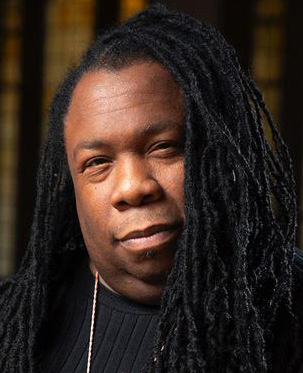
TJ Williams Hauger
My second term in my doctoral program reminded me of the sages who walked among the people and advocated for them, even while standing in the ivory towers and street corners of communities. As Howard Thurman would say, with their backs against the wall, they drew on the biblical scholarship of homiletics, specifically exploring the work of Frank Thomas. Thomas defines a “dangerous” sermon as one that challenges the comfort levels of congregants and society itself.
In my very first sermon for this class, I preached on Matthew 15, where the unnamed woman confronted Jesus’ humanity while simultaneously reminding him of his divinity. I asked the women in the classroom to put a mirror up to my face, which reminded me of my proximity to my privilege as a man married in an interracial relationship. I asked them for accountable accountability not just for that preached moment but for our entire time together until we graduate in 2028.
For this preached moment, I wanted to focus on individual piety and the mess that I, as an individual, stand in as a man in the church.
“I wanted to focus on individual piety and the mess that I, as an individual, stand in as a man in the church.”
Preaching dangerously for me meant confronting my own mess and saying to my sisters in my class, “Hold me accountable, so I can navigate my maleness, privilege and share a space and time for scholarship together, living fully with our collective humanity joined in unity and doing the deep work of scholarship.”
While this is one way of being authentic, there are other ways that must be honored as well. We cannot have a Jesus testimony focusing on personal piety without living in the world and carrying a message in our hearts for the people of God and for humanity. If there’s anything that will be said about my being an authentic spirit, then perhaps let there also be a lifting up of my critique of systems and powers that harm others — more than just myself as a Black queer man living in my social and political identity.
Being Black and queer and Christian means I must echo the words of the prophet Jeremiah who simply spoke God’s words to go and see about the least of these, to take care of the poor, to go see about the widow. Jeremiah used his privilege as a political prophet of his time to remind the political Jewish identity of his community that if they didn’t do so, they would have blood on their hands.
After finishing my master of divinity degree, I served as an intern at First Congregational Church of Glen Ellyn, Ill. I remember standing in the receiving line after I preached when a Black queer woman approached me, hugged me and said seeing me in the pulpit gave her the encouragement to keep going in her theological pursuits and ministerial conquests. She said seeing a Black queer man standing in a pulpit and preaching dangerously spoke to the very soul of her vocation.
“I know the power within me flows from my African ancestral lineage.”
I was humbled that day because I know the power within me flows from my African ancestral lineage. It represents my mother’s family, the Blackshears, and my father’s side, the Thomases, Malones and McClains. But it also represents the queer saints of yesterday on whose shoulders I stand every single time I put on a robe.
It was those voices and shoulders that gave me strength when I was dismissed from the Baptist World Alliance for being married to my husband. It was those voices that reminded me that even though whiteness is a privilege and men of privilege want you to go away, your ancestors want you to keep going and run on and see what the end will look like.
I am grateful for my African American ancestors, the elders from Jeremiah Wright, Jesse Jackson, my mother, evangelist Idells Cora Thomas and Bishop Yvette Flunder. Their unwavering support has fueled my determination to persevere, resist and stand tall in my authentic, beautiful brownness. The queer saints Bayard Rustin, Audree Lloyd, James Baldwin and Marsha P. Johnson have bestowed upon me a sense of empowerment and confidence, enabling me to navigate the challenges and mini attacks that come my way.
I am a living embodiment of Black history, a descendant of royalty, and I see in my eyes a powerful blend of black queerness. Without both progress and the moral arc of the universe bending toward justice, significant advancements in this country would not have been made.
On this Black History Month, let us stand tall, exuding confidence and recognize that all of us who are Black and brown are actively shaping Black history. We are Black history, and some of us are queer Black history with swag.
TJ Williams Hauger is a Baptist pastor in Chicago, an activist and content creator. He earned a master of divinity degree from New York Theological Seminary and is a doctoral student.