


There are moments in the history of political thought when two thinkers, separated by time and temperament, nevertheless circle the same human truth.
Edmund Burke and Alexis de Tocqueville lived in separate centuries — Burke, 18th; Tocqueville, 19th — but they shared a deep intuition: The health of a society depends less on its formal institutions than on the moral ecology of its everyday life.
Both understood political liberty is not sustained by abstract principles alone. It requires habits, affections and the slow apprenticeship of belonging. And both realized these habits are learned not in the glare of national politics but in the quieter, humbler spaces where people gather, work, worship and care for one another.
Burke called these spaces the “little platoons of society,” a phrase that still carries a surprising tenderness. Tocqueville, writing half a century later, spoke of “associations,” the voluntary groups Americans formed with astonishing ease — civic, religious, charitable, educational and everything in-between.
At first glance, the two concepts seem similar: both point to small-scale communities that mediate between the individual and the state. But the deeper one goes, the more their differences illuminate something essential about the modern world — the tension between inherited bonds and chosen commitments, between the givenness of life and the freedom to shape it.
What follows is an attempt to place Burke and Tocqueville in conversation — not as museum pieces of political theory, but as guides for a moment like ours, when loneliness and polarization coexist with a hunger for meaning and connection.
Burke’s “little platoons” — the first school of affection

Edmund Burke by Joshua Reynolds, National Galleries Scotland, Public Domain.

Burke’s “little platoons” appear in Reflections on the Revolution in France, a book often caricatured as a defense of hierarchy and tradition. But the phrase itself is not austere or reactionary. It is warm, almost domestic. Burke described the first attachments into which people are born — family, neighborhood, church, guild, the small circles of obligation that precede choice. These are not merely social conveniences. They are moral apprenticeships.
For Burke, affection is not a spontaneous sentiment. It is cultivated. And it is cultivated first in the places where we are known before we are impressive, loved before we are useful. The “little platoon” is where a child learns loyalty, patience, responsibility and the art of living with others who are not always easy to love. It is where the self is decentered, not by coercion but by affection.
Without these early attachments, Burke believed, the larger loves — love of country, love of humanity — become abstractions, easily manipulated by ideology.
This is why he distrusted the French revolutionaries’ attempt to rebuild society from universal principles alone. They wanted to leap directly from the isolated individual to the rational state, bypassing the messy, embodied communities that actually form human beings. Burke saw this as a kind of moral amputation. A society that severs itself from its little platoons loses the very soil in which virtue grows.
This insight is profoundly humane. Burke reminded us the moral life is not primarily a matter of grand gestures or heroic sacrifice. It is the accumulation of small fidelities — the daily work of showing up for the people who have been given to us, not chosen by us. In this sense, Burke’s little platoons are not nostalgic relics. They are the living tissues of any society that hopes to endure.
Tocqueville’s asssociations — freedom learned through practice

Alexis de Tocqueville by Théodore Chassériau, Public domain, via Wikimedia Commons
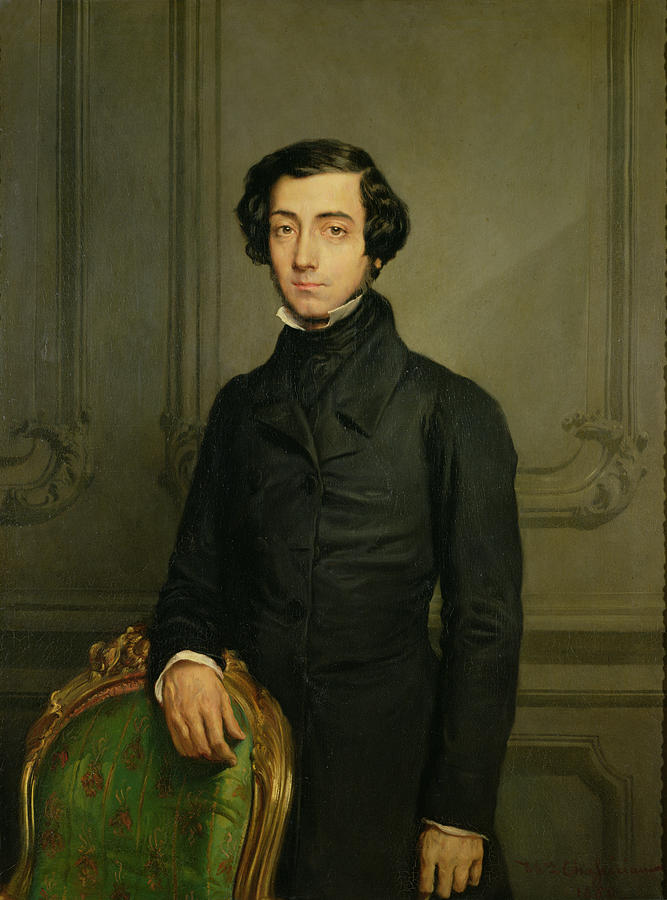
Tocqueville, writing in the 1830s, encountered a different social landscape. America was young, fluid, restless — a nation of joiners. What struck him was not inherited bonds but voluntary ones. Americans formed associations for everything — building schools, founding churches, improving roads, fighting intemperance, promoting the arts, caring for the poor. These associations were not imposed by tradition. They were chosen.
For Tocqueville, this was not merely a curiosity. It was the secret of American democracy. In Europe, he observed, people tended to oscillate between individualism and dependence on the state. But in America, associations taught citizens how to act together without waiting for government intervention. They were schools of self-government.
Where Burke emphasized affection, Tocqueville emphasized agency. Associations gave people practice in deliberation, compromise, leadership and responsibility. They created a civic muscle memory. And they prevented the kind of soft despotism Tocqueville feared — a paternalistic state that relieved citizens of the burden of caring for one another.
If Burke’s little platoons are rooted in the givenness of life, Tocqueville’s associations are rooted in the freedom to shape one’s social world. Together, they form a kind of dialectic — affection and agency, inheritance and initiative, the warmth of belonging and the discipline of cooperation.
Divergences — the moral middle space
Despite their differences, Burke and Tocqueville shared a profound intuition: The space between the individual and the state is where the moral life is formed. Both rejected the idea society can be sustained by isolated individuals or by centralized power. Both saw the need for mediating institutions — communities that are small enough to cultivate virtue but large enough to shape public life.
A society of unformed individuals is not free; it is vulnerable — to demagogues, to technocrats, to the loneliness that corrodes the soul.
And both understood something our own age often forgets: Freedom is not simply the absence of constraint; it is the presence of character. A society of unformed individuals is not free; it is vulnerable — to demagogues, to technocrats, to the loneliness that corrodes the soul. Founders like John Adams saw the presence of character among our citizens as vital to the sustainability of our constitutional republic.
Burke and Tocqueville also shared a suspicion of abstraction. They insisted real political life is lived in the particular, not in the universal. It is lived in the rhythms of congregations, the rituals of neighborhoods, the shared work of civic projects. These are the places where people learn to see one another not as categories but as neighbors.
In this sense, both thinkers offered a quiet rebuke to the hyper-individualism of modern life and the hyper-politicization of contemporary discourse. Their words remind us the most important work of democracy happens far from the national stage — in the patient, unglamorous labor of building communities that can bear the weight of human need.
Divergences — inheritance and choice
And yet the differences between Burke and Tocqueville matter. They reflect two visions of how social life is sustained.
Burke emphasized the moral authority of inherited institutions. He believed tradition carries a wisdom deeper than any individual can grasp. The little platoons are not chosen; they are received. They bind us to the dead and the unborn. They remind us we are part of a story larger than ourselves.
Tocqueville, by contrast, emphasized the creative energy of voluntary associations. He believed freedom is learned through practice and citizens must continually reinvent the social fabric. Associations are not inherited; they are built. They reflect the dynamism of democratic life.
Both visions contain truth. And both contain danger. Burke’s emphasis on inheritance can harden into nostalgia or exclusion. Tocqueville’s emphasis on choice can dissolve into fragmentation or consumerism. But taken together, they offer a more complete picture of human flourishing.
We need the stability of the little platoons — the places where we are loved before we perform. And we need the vitality of associations — the places where we learn to act together for the common good.
Why this matters now
We live in a moment when both the Burkean and Tocquevillian insights feel urgent. Loneliness is rising. Institutions are fraying. Trust is evaporating. And yet, beneath the surface, there is a quiet longing for connection — for communities that are neither coercive nor superficial, neither nostalgic nor rootless.
Burke’s ideas remind us we cannot build a humane society on choice alone. We need the unchosen bonds that anchor us — family, congregation, neighborhood, the people who hold us when we falter. Tocqueville’s insights remind us we cannot rely on inheritance alone. We need the chosen commitments that energize us — the associations that allow us to act together, to solve problems, to practice democracy.
In my own life, I have seen how these two visions converge. The communities that have shaped me most deeply were not glamorous. They were small, steady, imperfect and faithful. They taught me belonging is not a feeling but a practice. And they taught me that moral life is sustained not by heroic gestures but by the daily work of showing up — for family, for neighbors, for the vulnerable, for the common good.
Burke and Tocqueville, each in his own way, understood this. They understood the health of a society depends on the health of its middle spaces — the places where affection and agency meet, where people learn to love and to act, where the human heart is formed for freedom.

Joe Marlow
Joe Marlow is a theologian, historian, educator and writer now retired in South Lyon, Mich., with his wife, son, daughter-in-law and their two dogs. He used AI to research this article and to edit his first draft.
Related articles:
Against the grain: Rethinking the Whig interpretation of history
When Bill met Mike: An unlikely duo
John Adams and the discipline of seeing both sides