

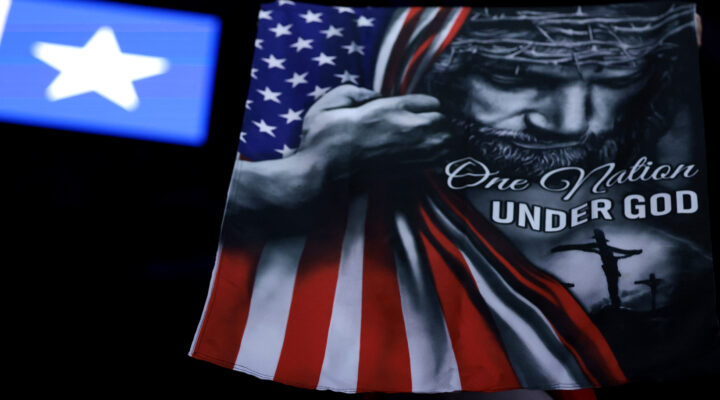
On May 17, Donald Trump plans to “rededicate” America as one nation under God.
The promotional material for the event says, “Rededicate 250 will gather a broad assembly of voices united by a love of God and country.” In fact, the assembly will be quite narrow. All people listed on the program are pro-Trump evangelicals or conservative Catholics, save one Jewish rabbi. There are no representatives of other faiths or even other traditions within Christianity. None. The musical guests are either military groups or come from evangelical colleges that support the president: Hillsdale College, Grand Canyon University, Liberty University.

Warren Throckmorton
Obviously, then, Trump intends this to be a gift to his evangelical base of supporters.
We can easily answer the question which God will be worshipped by observing the makeup of the people involved. Trump wants to rededicate the nation to the pro-Trump evangelical Christian god who helped elect him to office. But here is a more basic question: Is it possible for Trump to dedicate the nation to any god? Does the Constitution give him the authority to do that?
The short answer is no.
On May 17, Christian Scriptures will be read, Christian prayers will be said and Christian songs will be sung. With apologies to the lone rabbi, Jesus will headline the event.
“Trump wants to rededicate the nation to the pro-Trump evangelical Christian god who helped elect him to office.”
However, no matter how many prayers, songs and Scriptures are offered, the nation cannot be dedicated to Jesus. At least, not in any official sense. Donald Trump has no constitutional power to do it, and the First Amendment prohibits Congress from doing it.
All the hoopla is like professional wrestling — designed to have the appearance of reality but in fact, it’s all performance. My friend Gregory Thornbury tells me there’s a name for that kind of fakery in wrestling — “kayfabe.” And that’s what May 17 will be: Religious kayfabe.
In fact, Trump can’t rededicate the nation to Jesus because the United States never was dedicated to Jesus in any legal sense. Advocates of America as a Christian nation like to say the Puritans made a covenant with the Christian god, but even if they did, that was long before the Constitution was written. Those same Christian nation advocates like to say the Constitution was based on the Bible. In fact, our current system of government wasn’t founded as a religious enterprise. When the delegates met in Philadelphia in 1787, they weren’t thinking about how to create a Christian republic. They didn’t begin the convention with prayer or dedicate it to God. They had been meeting for over a month before Benjamin Franklin suggested the delegates should open each day’s session with prayer. However, the delegates never voted on Franklin’s motion, effectively killing it. Franklin later wrote in his journal that the “convention, except three or four persons, thought prayers unnecessary.” Keep that in mind when you hear Christian nationalist stories of delegates praying and the Constitutional Convention being rescued by supplication to God.
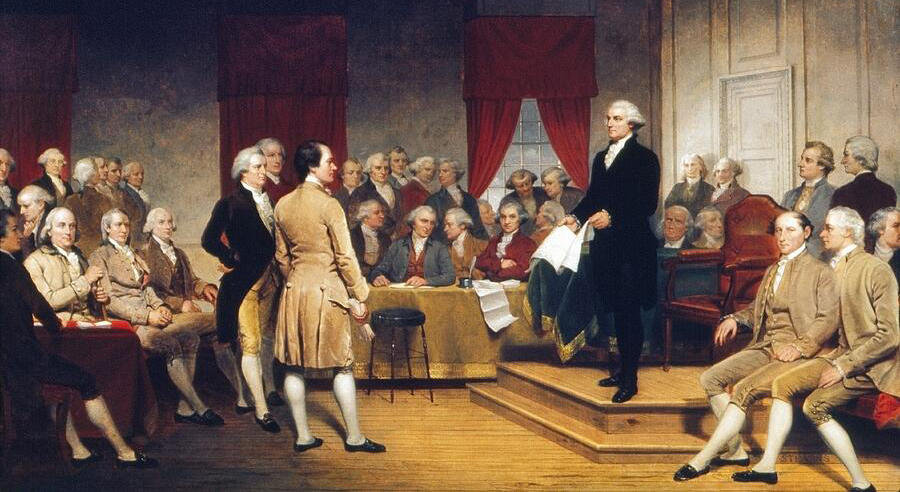
“Constitutional Convention,” painting by Granger
The delegates rarely mentioned religion in their deliberations. At times they seemed indifferent to religion. Pennsylvania delegate Gouverneur Morris said, “Reason tells us we are but men; and we are not to expect any particular interference of Heaven in our favor.”
Speaking about slavery, South Carolina’s John Rutledge declared that “religion and humanity had nothing to do with this question.” For him, the only real question was “whether the Southern States shall or shall not be parties to the Union.” He advised it was in the interest of the Northern states to allow slavery. Actually, a little anti-slavery religion might have helped at that point, but the delegates as a group lost their faith when African slaves needed it the most.
The delegates did not mention any god in the Constitution. They did not call for allegiance to any deity. The only mention of religion was to prohibit a religious test for public service in the new government. The new government of the United States was to be neutral when it came to religion.
“The only mention of religion was to prohibit a religious test for public service in the new government.”
Then just a short time later, many of those same founders passed a Bill of Rights which included a prohibition on the establishment of religion while allowing the free exercise of religion — any religion, not just Christianity.
Preachers at the time understood much better than many of our current crop of Christian nation advocates what had happened in 1787. Timothy Dwight, president of Yale University, preached in 1812 that the U.S. had begun its national existence without any thought of God. Really, Dr. Dwight? But our kayfabe historians today tell us we were founded on Christian principles and had a Christian beginning. Many honest observers at the time knew better.
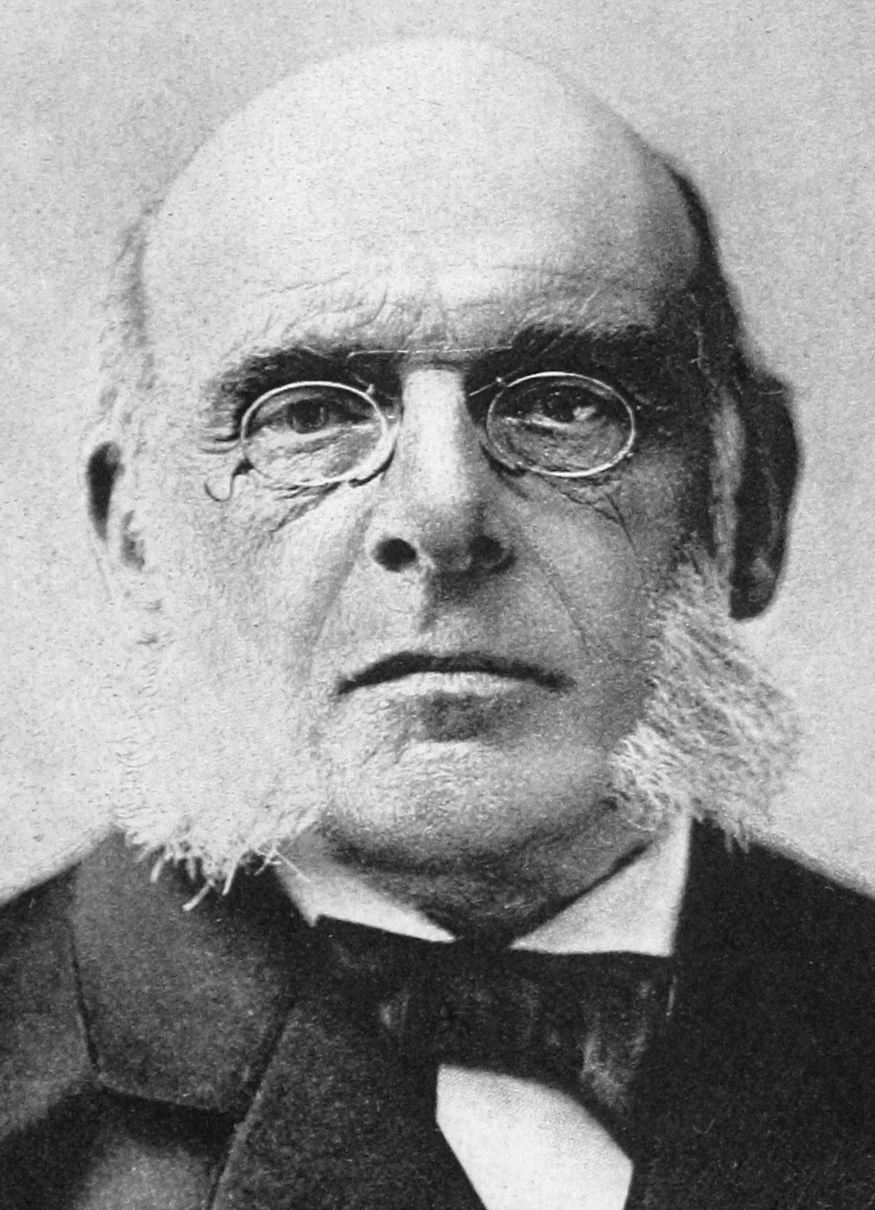
Timothy Dwight
Dwight said the nation was sinful because “we formed our Constitution without any acknowledgment of God; without any recognition of his mercies to us, as a people, of his government, or even of his existence.” According to the president of Yale, God was missing from the convention.
Dwight continued speaking about the Constitution: “The Convention, by which it was formed, never asked, even once, his direction, or his blessing upon their labours. Thus, we commenced our national existence under the present system, without God.”
Not long after the Founders died off, conservative Christians started a project that persists to this day. Listen to historian Gillis Harp describe their moves: “They modified conceptions of church-state relations that had been prevalent during the Founding era and developed a historical interpretation of the United States as a Christian nation.”
Steven K. Green’s assessment of the generation after the founding also describes Christian nationalists of today: “The idea of America’s religiously inspired founding was a consciously created myth constructed by the second generation of Americans in their quest to forge a national identity, one that would reinforce their ideals and aspirations for the new nation.”
This generation continues that quest.
Donald Trump’s Rededicate 250 is perhaps the zenith of the effort, but whatever else you say about it, it is religious kayfabe. After all the prayers have been prayed, songs have been sung and sermons have been preached, the fact remains that the beginning of our system of government was not religious and certainly not Christian. The Founders, religious and nonreligious, deliberately took religion out of the federal government and put it where it belongs: in houses of worship and with the people.
Hopefully, someday, we will get back to an administration that respects the actual founding and not the mythical one embellished with religious kayfabe.
 I know there are some readers who are jumping up and down quoting George Washington’s days of prayer and thanksgiving. While it is true that Washington called on the nation to pray and thank God, his call was a general one to those who believed in a supreme being and was not exclusive to Christianity. Furthermore, the presidents who followed him disagreed with his practice.
For instance, John Adams regretted his call to a day of prayer, later saying it may have been the reason he was not reelected.
Third in office Thomas Jefferson declined to issue a call to prayer, saying, “I consider the government of the U.S. as interdicted by the Constitution from intermeddling with religious institutions, their doctrines, discipline or exercises. This results not only from the provision that no law shall be made respecting the establishment, or free exercise, of religion, but from that also which reserves to the states the powers not delegated to the U.S., certainly, no power to prescribe any religious exercise, or to assume authority in religious discipline, has been delegated to the general government.”
President James Madison also spoke against national religious gestures: “They (religious proclamations) seem (to) imply and certainly nourish the erroneous idea of a national religion.”
Trump’s Rededicate 250 is Exhibit A for Madison’s concern. Save one conservative Jewish rabbi, every other participant in the event is a pro-Trump conservative Christian. Trump’s religious entourage clearly is dedicating the nation to the pro-Trump, conservative Christian god.
Good thing it is all kayfabe. Unless the Constitution is set aside, it doesn’t mean a thing. After all is said and done, the Constitution is still the law of the land, not the Donald Trump Commemorative Bible.
Warren Throckmorton is author of The Christian Past That Wasn’t: Debunking the Christian Nationalist Myths That Hijack History to be published May 19 by Broadleaf Books.
Related articles:
Is it time to retire the term ‘Christian nationalism’? | Opinion by Warren Throckmorton
Evangelicals will dominate at ‘Rededicate 250’ this weekend
When government claims God | Opinion by Amanda Tyler