

Opposition to capital punishment isn’t just for liberals anymore.
There’s a growing concern about the inequity and ineffectiveness of the death penalty among Republicans, independents and libertarians, according to Hannah Cox, senior national manager of Conservatives Concerned About the Death Penalty.
Cox came to the role about two years ago from the Beacon Center of Tennessee, a free market think tank. Prior to that, she worked for the Tennessee Firearms Association and the National Alliance on Mental Illness. She hails from Alabama and is the daughter of a Southern Baptist pastor.
In the 2020 legislative season, Republican legislators have sponsored death penalty repeal bills in eight states: Georgia, Pennsylvania, Wyoming, Missouri, Kansas, Ohio, Colorado and Washington. Republican lawmakers also played a key role in recent votes in Colorado to repeal that state’s death penalty. Last year, 40% of the New Hampshire Senate Republican caucus voted to override their own GOP governor’s veto and repeal the death penalty there.
According to data collected by Conservatives Concerned About the Death Penalty, the number of Republican state lawmakers sponsoring death penalty repeal bills has increased sharply since 2012. And since 2016, more than 67% of the Republicans sponsoring death penalty repeal bills did so in states controlled by Republican leadership.

Hannah Cox
While this trend might surprise some, it should be seen as consistent with true conservative values, Cox said. She sees conservative Republican state legislators who believe in limited government, fiscal responsibility and who value life moving away from capital punishment.
That’s a contrast to the Trump administration’s Justice Department, which in its waning days in power has rushed to execute five more death-row prisoners — after already killing more death row inmates in five months of this year than the federal government had executed in the previous 50 years. And to the Justice Department’s efforts to return firing squads and electrocution as means of capital punishment.
Despite that appearance, inertia among political conservatives in America is running away from the death penalty, Cox said. “It’s a dying system. … It’s not something people are clinging to. The only opposition to getting rid of it really is the prosecutor’s association.”
Prosecutors like the ability to make names for themselves in high-profile death penalty cases, she said. Such tough-on-crime publicity often prepares them to run for higher office.
But the facts tell a different story, Cox said.
“At the end of the day, we know that it’s not a deterrent. It wastes millions of dollars that could be spent on crime.”
“A lot of people who are conservatives also care about repealing the death penalty,” she explained. “At the end of the day, we know that it’s not a deterrent. It wastes millions of dollars that could be spent on crime. We know that the death penalty risks innocent life every time it’s carried out. We have seen one innocent person exonerated for every nine executions carried out.”
And conservatives who are Christians especially should be concerned about the death penalty, she added. “As a Christian myself, I know we believe in redemption. There should be justice and accountability and some way they are asked to make amends. But we shouldn’t remove the factor of redemption. We don’t think people are defined by the worst thing they ever do.”
Her message is received “very well” with political conservatives, she said. “There’s a perception that’s no longer true that Americans support the death penalty. They don’t. … This is something both sides will come together on, something the voters are demanding. … There’s a hunger for change, a hunger for new ideas. People are really excited to find we exist or maybe taken aback and are really curious about what they’re missing.”
“They didn’t know there were other conservatives who thought like this.”
Most often, she said, conservatives who discover her organization are surprised and grateful to learn there are other conservatives who share their reservations about capital punishment. “They didn’t know there were other conservatives who thought like this.”
Gallup recently reported that Americans’ support for capital punishment continues to be lower than at any point in nearly five decades. Fewer than six in 10 Americans (55%) are in favor of the death penalty for convicted murderers. Death penalty support has not been lower since 1972, when 50% were in favor.
“Many Americans are … conflicted on the death penalty,” Gallup reported. “Gallup trend questions indicate that about one in five Americans express theoretical support for use of the death penalty but believe life imprisonment is a better way to punish convicted murderers.”
And that’s just the message Cox and her allies want to get out: A sentence of life without parole is a better alternative for murder cases than capital punishment.
This death penalty system in America “doesn’t live up to our values and protect the sanctity of life,” she said. “It is not fiscal conservativism. It doesn’t work to deter crime. It wastes millions of dollars that could be spent on crime. It doesn’t give victims or their family members the healing they need. It’s wasteful in a way that actually makes our communities less safe.”
Data collected by the Death Penalty Information Center supports her arguments:
- North Carolina spends $2.6 million more on every capital punishment case than it does on cases where a life without parole sentence is chosen.
- In Oklahoma, capital cases cost an average of 3.2 times as much taxpayer money as non-capital cases.
- The states that carry out the largest numbers of executions still have the highest murder rates, proving that the death penalty is not a deterrent.
- 88% of the nation’s top academic criminology societies have said the death penalty is not a deterrent to murder.
- Death row inmates are disproportionately Black compared to the population at large, while the victims of capital cases are disproportionately white. The center noted: “More than 75% of the murder victims in cases resulting in an execution were white, even though nationally only 50% of murder victims generally are white.”
And again, despite popular perceptions, family members of murder victims today often are the ones leading the charge against capital punishment, Cox said. “A lot of them feel that murdering the person is not going to bring them closure.”
 The actual use of capital punishment is isolated to relatively few places in America, Cox noted, reporting that 2% of U.S. counties produce the majority of death penalty cases today.
According to data reported by the Death Penalty Information Center, Texas leads the nation in number of executions carried out in the last two years, with 12. Since 1976, Texas has executed 570 people, nearly five times as many as any other state.
California currently has the largest number of convicts on death row (724) but has not carried out an execution since 2006 because of a moratorium imposed by the governor.
As of July 1, there were 2,591 people on death row nationwide, including 62 held in federal prisons.
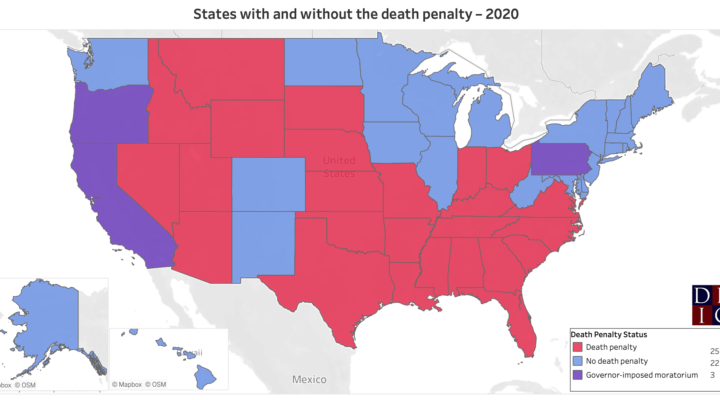
Conservatives Concerned About the Death Penalty has as its goal the elimination of the death penalty in America, at both the state and federal levels. Currently only half the U.S. states have death penalty provisions on the books. According to Cox, there are only 13 states “active” in the capital punishment business. Those include seven that have carried out executions in the past two years: Texas, Florida, Missouri, Georgia, Alabama, Tennessee, South Dakota.
Next year’s legislative focus will be on Wyoming and Ohio, where legislation is projected to advance to outlaw capital punishment. Ohio has executed 56 people since 1976 but none in the last two years. Wyoming has executed one person since 1976 but none in the last two years.
Conservatives Concerned About the Death Penalty currently lists 13 state groups: Florida, Georgia, Ohio, Kansas, Kentucky, Missouri, Montana, Nebraska, North Carolina, Tennessee, Utah, Washington, Wyoming.
Related articles:
After 23 years in prison, Curtis Flowers is free
Curtis Flowers was tried 6 times for the same crime. His story reveals 3 kinds of Christians