


Recently after worship at First Baptist Church, Asheville, N.C., where I’m the interim minister of music, a choir member approached me almost as soon as the pastor had finished the benediction and said, “Doug, I’m scared.”
Looking into this diminutive senior adult singer’s blue eyes, her soft voice almost quavered as she talked about her real fears when she read about the actions of the current administration in Washington, D.C. And then she asked this profound question, “What should I pray for?”
In this moment I felt the weight of being a pastor. What could I say that would offer genuine comfort without false promises?
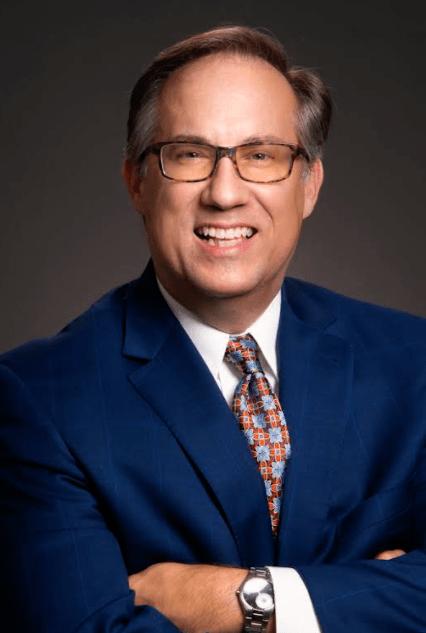
Doug Haney
Her question stayed with me because I knew she wasn’t alone in feeling this way. To my friends who are reading this and did not vote for the current administration, I imagine you understand the sentiment of this church member. To my friends who did vote for this administration, you might dismiss her expression of fear as “pearl clutching” or someone who is reading the wrong news sources that are unnecessarily stoking these fears.
What could I say that might be helpful and not harmful?
First, America has weathered profound chaos before — the Civil War most bloodily, but also the economic collapse and distrust of the early 1930s. Read Andrew Ross Sorkin’s new book, 1929, about the time just before and after the stock market crash in October 1929.
Now, some political commentators and historians say this current moment is unique and already has done lasting damage to American democracy. Time will tell. But when one reflects on the history of America there seems to be a remarkable resilience.
Let us pray that God will “mend our every flaw,” as we sing in “America the Beautiful.”
Second, I encouraged my friend to read the psalms. Every day. The psalmist speaks of life as it is. The psalmist’s language is sometimes trusting and hopeful, and sometimes doubting and dejected. The hymns of the Hebrew people are an anchor in the storms of this life.
Third, I told my friend, keep singing. Just the Wednesday before at rehearsal I had shown the choir a little plaque given to me by my friend Frances Jones, at Wilshire Baptist Church in Dallas. The plaque reads: “Singing is praying twice.”
This quotation, attributed to St. Augustine, has almost become a mantra for me in music ministry. Singing is a spiritual practice that brings us close to God even when our own words fail us.
For those who find my advice only so much pablum and utterly lacking in sophistication and real-world action, I get it. At the end of the day, go vote. But in this moment after worship on a Sunday morning, this was not a time for political strategy. This was a moment to practice pastoral care.
In 1869 in a collection titled “Bright Jewels for the Sunday School” Baptist minister Robert Lowry contributed the hymn “How Can I Keep from Singing.” In the 1950s this hymn was adapted by folk singer Pete Seeger. These lines have never seemed more timely, offering the same assurance I hoped to give my friend that Sunday morning:
No storm can shake my inmost calm while to that Rock I’m clinging,
Since Love is lord of heaven and earth, how can I keep from singing?
Doug Haney lives in Rock Hill, S.C., and leads a national network of church musicians called Polyphony. He served churches in Texas, North Carolina and Georgia as minister of music. He currently serves as interim minister of music at First Baptist Church of Asheville, N.C.