


A conservative think tank known for attempts to teach alternatives to evolution in public schools is capitalizing on the first total solar eclipse to sweep coast-to-coast in 99 years to advance the hypothesis that life is too complex to have evolved by random chance.
The Seattle, Wash.,-based Discovery Institute recently published a series of articles describing the Aug. 21 total solar eclipse along a 60-mile wide strip from Salem, Ore., to Charleston, S.C., as a teachable moment for proponents of Intelligent Design, a controversial alternative to Darwinian evolution judged by a federal court in 2005 to be a form of creation science inappropriate to teach in public schools.
The Privileged Planet, a book and film by two scientists associated with the Discovery Institute, submits that in addition to being ideally situated to support complex life, Earth is also fine-tuned for scientific discovery.
In their book, originally released in 2004, professors Jay Richards of the Catholic University of America and Guillermo Gonzalez of Ball State University say eclipses are not only awe-inspiring but have played a major role in scientific discovery, such as observations during a 1919 eclipse that confirmed the bending of light predicted by Einstein’s Theory of Relativity.
“The Earth’s surface provides the best view of solar eclipses in the solar system,” says a synopsis of The Privileged Planet on the authors’ website. “The Earth’s surface is also the most habitable place in the solar system. Is this coincidence just that? In The Privileged Planet, we argue that it isn’t. The conditions that make a planet habitable also make its inhabitants more likely to see solar eclipses.”
Mathematician and philosopher William Dembski, dean of the Intelligent Design movement, made the same argument in his 2008 book Understanding Intelligent Design co-authored with Sean McDowell, an author and editor with a Ph.D. in apologetics and worldview from Southern Baptist Theological Seminary in Louisville, Ky.
“Astronomers place telescopes where the conditions for viewing are most favorable,” said McDowell and Dembski. “Telescopes don’t exist on mountaintops by chance or by some law of nature — they’re put there by design. Earth is much like a telescope on top of a mountain — it’s located where viewing conditions are best.”
Dembski formerly taught not only at Southern Seminary but also Baptist-affiliated Baylor University and Southwestern Baptist Theological Seminary, as well as the independent Southern Evangelical Seminary in Charlotte, N.C., led by former Southern Baptist Convention ethicist Richard Land.
NASA describes a solar eclipse as a celestial event in which the moon passes between the sun and Earth and blocks all or part of the sun for up to about three hours, from beginning to end, as viewed from a given location.
A solar eclipse takes place approximately every 18 months, but it appears rare because the total effect is observable only in places where the moon and sun are nearly perfectly aligned. Because so much of the planet is covered with water, it almost always happens over an ocean.
The last solar eclipse to pass an American state was in Hawaii in 1991. The path of totality last touched the contiguous 48 states in 1979 over a corner of the Pacific Northwest. The last total eclipse to pass across the U.S. from the Pacific to the Atlantic was in 1918.
On average the same spot on Earth gets to see a solar eclipse every 375 years, but Americans in a line from San Antonio, Texas, to northern Maine will get their chance as soon as 2024. For folks in Carbondale, Ill, — near the central line of both this year’s eclipse and the next one — the wait is only seven years.
While tens of millions of will be in the path of totality in Monday’s eclipse, every single spot in the continental United States will see an eclipse up to 60 percent. The only safe way to look directly at the uneclipsed or partially eclipsed sun is through special-purpose solar filters, such as eclipse glasses or hand-held solar viewers.
Caleb A. Scharf, director of astrobiology at Columbia University, calls the fact the moon so nearly blots out the sun during a total eclipse “an interesting coincidence” that is “nothing obviously special, just rather good luck” in a 2012 article published by Scientific American.
Earth is the only place in our solar system where the sun is 400 times larger than the moon but also 400 times farther away, making them appear the same size to the viewer of a total eclipse. Scientists cannot calculate the odds of it happening it happening elsewhere, because they don’t know how many planets in other solar systems have moons.
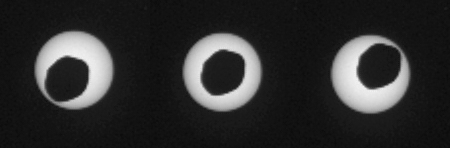
This set of three images shows views three seconds apart as the larger of Mars’ two moons, Phobos, passed directly in front of the sun as seen by NASA’s Mars rover Curiosity on Aug. 20, 2013. (Photo/NASA/JPL-Caltech/Malin Space Science Systems/Texas A&M Univ.)
In a recent article Scharf said angular eclipses, where a moon is too close and too small to blot out the entire sun, happen on Mars almost every day. Because the distance from the earth to the moon increases by a few centimeters a year, scientists say the moon will be too far away and its apparent size too small to completely cover the sun anywhere on our planet in about 100 million years.
Founded in 1991 by former Reagan administration official Bruce Chapman, the Discovery Institute self-describes as “an inter-disciplinary community of scholars and policy advocates dedicated to the reinvigoration of traditional Western principles and institutions and the worldview from which they issued.”
The institute’s overarching vision is expressed in the understanding that human beings and nature are the result of an intelligent design rather than a blind and undirected process. A founding document outlines goals “to defeat scientific materialism and its destructive moral, cultural and political legacies” and “to replace materialistic explanations with the theistic understanding that nature and human beings are created by God.”
The group claims to be secular, but critics such as Americans United for Separation of Church and State say its real purpose is to undercut church-state separation and turn public schools into religious indoctrination centers.
In 2005 a district judge in the legal case Kitzmiller v. Dover ruled that Intelligent Design is a form of creationism — the religious belief that the universe and living organisms originate from specific acts of divine creation taught in the Bible rather than by natural processes such as evolution — and therefore unconstitutional to teach in American public schools.