


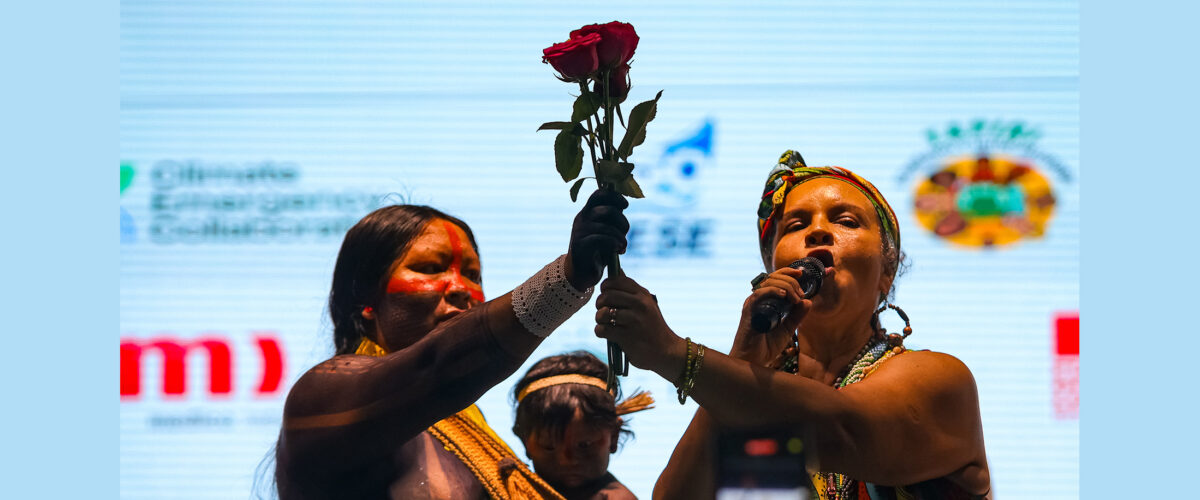
Naira Santa Rita, an internally displaced person from Brazil, directed her message to the entire audience: “Anyone of us in this room could be a climate refugee.”
In a space shared by people from across the world, these were the words that stuck with us as we left our first COP30 panel, which focused on solutions for refugees, internally displaced people and migrants.
COP30 is the United Nations Climate Change Conference currently taking place in Belém, Brazil.

Naira Santa Rita
The panel’s speakers exemplified the ubiquity of climate migration: Naira, an internally displaced person from Brazil; Gardenia Cooper Guiroz Warao, an indigenous refugee representative from Venezuela; and Ayoo Irene Hellen, a refugee from South Sudan living in Uganda. The panel also included Filippo Grandi, United Nations High Commissioner for Refugees; Ugochi Daniels, U.N. International Organization for Migration deputy director general; and Abdirasak Ahmed Ali, director general of Somalia ministry of environment and climate change.
Climate migration occurs across and within borders, and it often affects communities that aren’t given a seat at the table. As a refugee from Uganda, Ayoo highlighted Uganda’s leading role in considering refugees in their national adaptation plan by incorporating solar electric cooking. Eighty percent of refugees from South Sudan are women and children, and they often encounter harassment, assault and even arrest while searching for firewood in times of energy scarcity. Children have dropped out of school solely due to the time spent gathering firewood. By implementing solar electric cooking, Uganda addresses a humanitarian and climate crisis simultaneously — two sides of the same coin.
Humanitarian crises affect all people, not only as nations receive more and more refugees, but also when citizens begin to migrate. Climate change migration might evoke a sensational picture: thousands of refugees in search of a new home after a devastating hurricane; flooding of international borders as communities face a nation-wide drought. However, not all climate migration makes headlines.
As sea levels and temperatures slowly creep up, so will rates of migration. More legal frameworks are required for addressing the diverse catalysts for migration. The more gradual and less frantic kinds of migration, such as a Texan who decides to move to California because they simply can’t bear the increasing heat, are difficult to measure.
Less than 10% of climate finance goes to communities most in need.
Commissioner Grandi spoke about the continued importance of humanitarian aid while stressing it still leaves much to be desired. This sentiment was echoed by Ugochi Daniels, who remarked: “Climate finance is a very important part, but it’s not enough. It’s not going to the countries that need it.” According to Daniels, less than 10% of climate finance goes to communities most in need.
As finance remains a central topic at COP30, it will remain equally important to address how funds are being directed, panelists said. Responding to concerns about addressing displacement across the world, Grandi emphasized that all forced migration is unjust. However, a good place to start addressing forced migration is climate justice.
In the heart of the Amazon, one of the elephants in the room is the impact of climate change on indigenous communities — those who have polluted the least yet suffer the most. Gardenia spoke about her community’s direct connection with nature and how more indigenous voices need to be amplified when it comes to environmental care. This is a sentiment that has echoed throughout the entire COP — as humans separate from nature, they begin to damage it as if they aren’t damaging themselves.
Connection with nature, the community, and love for neighbor never feels stronger than when we sit together with advocates from around the globe, the speakers urged.
Political, cultural and religious work in America must come from a place of love and the understanding that we truly are all neighbors of one shared planet, Commissioner Grandi emphasized: “Let’s not take it for granted that everybody agrees or knows” that climate change is real.
The first step to combatting climate change is acknowledging its existence, and the second is acknowledging its ongoing effects throughout the entire world. he said, adding that climate migration demands that love for neighbor must extend not only to neighbors across the street but also to neighbors across the world.
This content is made possible by a partnership between Baptist News Global and Texas Impact.
Related articles: