


A coalition of anti-death penalty groups has united to end capital punishment state by state and just as U.S. executions are surging.
The alliance of more than 50 organizations was launched earlier this month to coordinate nationwide abolition efforts led by Death Row exonerees and a range of religious, conservative and civil rights groups.

Laura Porter
“In this moment, we see a very clear disconnect between the handful of politicians pushing for more executions and the expansion of the death penalty and current public sentiment on this issue,” said Laura Porter, director of the new U.S. Campaign to End the Death Penalty. “We want to make sure policymakers know the country is moving away from the death penalty. The surge in executions and efforts to expand the death penalty are out of touch with the views of Americans.”
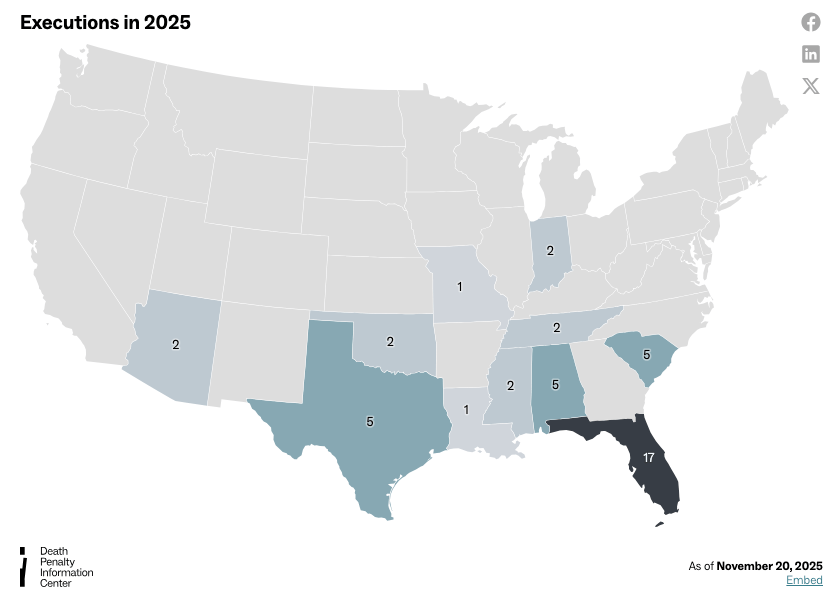
But governors in several states have yet to heed that message. This year, 44 prisoners have been executed across 11 states, compared to 25 total in 2024 and 23 total the previous year, according to the Death Penalty Information Center. Florida leads the way by far with 17 executions in 2025, followed by Louisiana, South Carolina and Texas with five executions apiece.
The spike also comes as some of the nation’s 27 death penalty states are widening execution methods to include the electric chair, firing squad and toxic gas. Secretive practices around lethal injection chemicals, along with the controversial and untested use of gas, is contributing to increasingly agonizing prisoner deaths.
Porter pointed to recent Gallup research indicating overall support for the death penalty has dropped to 52%, the lowest level in 50 years.
“In addition to public polling, new death sentences remain at historic lows,” she added. “In a country of 348 million people, there will be less than 30 new death sentences in 2025. There is no greater indicator of how Americans feel about the death penalty than in the jury room, and juries are sending very few people to Death Row.”

Barry Scheck
Barry Scheck, co-founder and special counsel of the Innocence Project, said the campaign is needed to educate Americans about the tragic truths of the death penalty: “Reasonable people can differ about the moral question of capital punishment, but reasonable people cannot differ over certain facts that we know over the last few decades.”
One of those is that innocent people have been executed and that 201 condemned prisoners have been released. The practice is also prohibitively expensive and does not live up to the promise of preventing crime, Scheck said.
“It serves no good public function, and it certainly isn’t making people feel safer. And what is troubling, is that in many states now there are politicians who are actually trying to advance themselves by calling for death. And in our experience in the innocence movement, nothing guarantees a wrongful conviction more than making it a big political issue.”

Alexis Hoag-Fordjour
At the same time, federal courts have ceased providing meaningful judicial review of state death sentences, said Alexis Hoag-Fordjour, a professor at Brooklyn Law School.
“We’re now operating a capital punishment system without a safety net. Federal courts are meant to act as this backstop, stepping in when state courts failed to protect the basic rights of defendants. But over the last 15 years that stopgap has been eviscerated.”
That is due to the U.S. Supreme Court’s narrow interpretation of the Anti-Terrorism and Effective Death Penalty Act, which turned federal judicial oversight into a “virtual mirage,” she explained. “It values finality over accuracy, deterrence over justice, and the human consequences of that shift are devastating.”
Education is a vital part of the campaign because the more Americans learn about the death penalty, the more they will oppose it, said Sister Helen Prejean, a Catholic nun, activist and author of Dead Man Walking. “But because the death penalty is such a semi-secret ritual behind prison walls, people don’t see it, and there is this saying in Latin America, ‘What the eye does not see, the heart cannot feel.’”
In 35 years of anti-execution advocacy, Prejean said she has seen minds open to knowledge that public safety is not dependent on killing and death.
“When you look at the death penalty itself, it epitomizes all the deep wounds in our society, (including the) use violence and cruelty to solve social problems, which is the national rhetoric sent down from Trump,” she added. “It’s in the air. It’s in the national rhetoric. The language is so harsh, but the people get it.”
Republicans are increasingly getting it, too, said Demetrius Minor, executive director of Conservatives Concerned about the Death Penalty.
“Republicans and conservatives across the country dialogue about the failures of the policy of capital punishment,” he said. “More and more conservatives across the country are questioning the death penalty and advocating for change.”
Many conservative allies view the death penalty as a pro-life issue and oppose it as an example of big government programs and overreach, Minor said. “The past two years, Republicans have introduced repeal or moratorium legislation in Indiana, Missouri, Ohio, Pennsylvania, Kentucky and Oklahoma.”
Hoag-Fordjour, Prejean and Schenk are members of the campaign’s advisory council, which also includes Mike Farrell, president of Death Penalty Focus and a former actor known for his role as B.J. Hunnicutt on MASH.
Porter also serves as executive director of the 8th Amendment Project and formerly served as director of campaigns and strategy with Equal Justice USA, a nonprofit group that ceased operations this year due to the sudden loss of federal grants.