


This past week, I received a link to an article on the Christian news satire website, The Babylon Bee. The article was titled “Baptist Conclave to Choose A New John MacArthur.”
It was clever and funny. It pictured 12 older men sitting expressionless in a semi-circle beneath the pulpit in a small church. Each was dressed in a stereotypical black preaching suit with white shirt and tie. It is a stark contrast to the cardinals at the recent Papal Conclave, all clad in scarlet cassocks, with a matching sash, cape and cap. The point was clear. Selecting the new John MacArthur was the equivalent of choosing the next Baptist pope.
An article on the Moody Bible Institute website described MacArthur as “one of the most influential evangelical leaders of his time.” There is much to support this claim. His conferences, books, commentaries, radio broadcasts, archived sermons and study Bible have shaped Protestant Christianity in America and worldwide for more than half a century and likely will continue to do so for some time.

Was he a Baptist?
One might argue that MacArthur’s enormous impact on preachers surpassed Billy Graham and Jerry Falwell combined. Still, I wonder. Was he a Baptist?
Several obituaries described him as “the son of Baptist radio preacher.” John MacArthur’s father, Jack MacArthur, attended Bob Jones University in Greenville, S.C., founded by and named for the fundamentalist Methodist preacher, and he graduated from the Northern Baptist Convention affiliated Eastern Baptist Theological Seminary in Philadelphia. He moved to California, where he briefly served as pastor of two congregations: Fountain Avenue Baptist Church in Los Angeles and First Baptist Church Downey, connected with the Baptist General Conference (the old Swedish Baptists) before forming the nondenominational Calvary Bible Church in Glendale, Calif., which he served for 50 years. But he was perhaps best known as a radio preacher of the Voice of Calvary program.

Jack MacArthur and “The Voice of Calvary”
Despite his interdenominational involvements, it seems plausible that Jack MacArthur still thought of himself as a Baptist preacher. But what about his son?
Like his father, John MacArthur attended Bob Jones University. MacArthur also graduated from the interdenominational Bible Institute of Los Angeles. He served more than 50 years as pastor of the nondenominational Grace Community Church of Los Angeles. In 1985, John MacArthur became president of Los Angeles Baptist College, which soon changed its name to The Master’s University and dropped its Baptist identity. He was baptized by and formed in Baptist churches and institutions, but in his entire ministry, he never served a Baptist church.
Although MacArthur had no formal connection with any Baptist church or denomination, the case still could be made that his faith and practice was broadly baptistic. In 2009, at a retrospective on 40 years of ministry at Grace Community Church, MacArthur related a story about a conversation he once had with W.A. Criswell, the longtime Southern Baptist pastor of First Baptist Church of Dallas, at a pastors’ conference in Jacksonville, Fla.
Criswell asked MacArthur, “Do people who join your church have to be real Christians?”
MacArthur said, “Yes, sir.”
Criswell continued, “Do people who join your church have to be baptized?”
MacArthur said, “Yes, sir.”
Criswell pushed further, “Do you baptize people by putting them all the way in the water?”
MacArthur replied, “Yes, sir.”
Then Criswell said, “Boy, you are a Baptist.”
MacArthur took that endorsement as sufficient to justify his Baptist identity.

John MacArthur
His answer to Criswell was borne out in his ministry. In a sermon MacArthur preached at Grace Community Church Sept. 18, 2011, he addressed the question “Is infant baptism biblical?” He answered a resounding, “No!” giving five reasons.
His first was simple: “Infant baptism is not in the Scripture.” He asserted, “There are no arguments for infant baptism explicitly and there are no arguments that are necessary, inescapable, clear and compelling from Scripture — none whatsoever.”
He argued that believers’ baptism by immersion is the only biblically warranted practice of Christian baptism, and he concluded that believers’ baptism ensures the biblical witness to a believers’ church.
The Reformed tradition
Yet if MacArthur was a Baptist, he was a Reformed Baptist who adhered to the doctrines of the Westminster Confession and the Baptist parallel, the Philadelphia Confession of Faith. He preached a sermon at Grace Community Church on Sept. 18, 2005, titled “The Doctrine of God’s Effectual Call.” In it he affirmed the teaching that “all those whom God hath predestinated unto life, and those only, he is pleased, in his appointed and accepted time, effectually to call . . . drawing them to Jesus Christ, yet so, as they come most freely, being made willing by his grace” (Westminster Confession, 10.1).
“MacArthur argued God only gives the grace to be saved to those whom God already has chosen.”
In that sermon, MacArthur argued God only gives the grace to be saved to those whom God already has chosen. Sinners are called to accept Christ, he exclaimed, because they already have been chosen by God. Such strong Calvinism bumps up against popular evangelical Baptist convictions that “God is not willing that any should perish, but that all should come to repentance” (2 Peter 3:9) and “whosoever will, let them take the water of life freely” (Revelation 22:17).
To be sure, MacArthur’s Reformed convictions may be unpopular with many Baptists, but that alone is not enough to disqualify his Baptist identity. There are plenty of Baptists from John Bunyan to John Piper who held to the “doctrines of grace.”
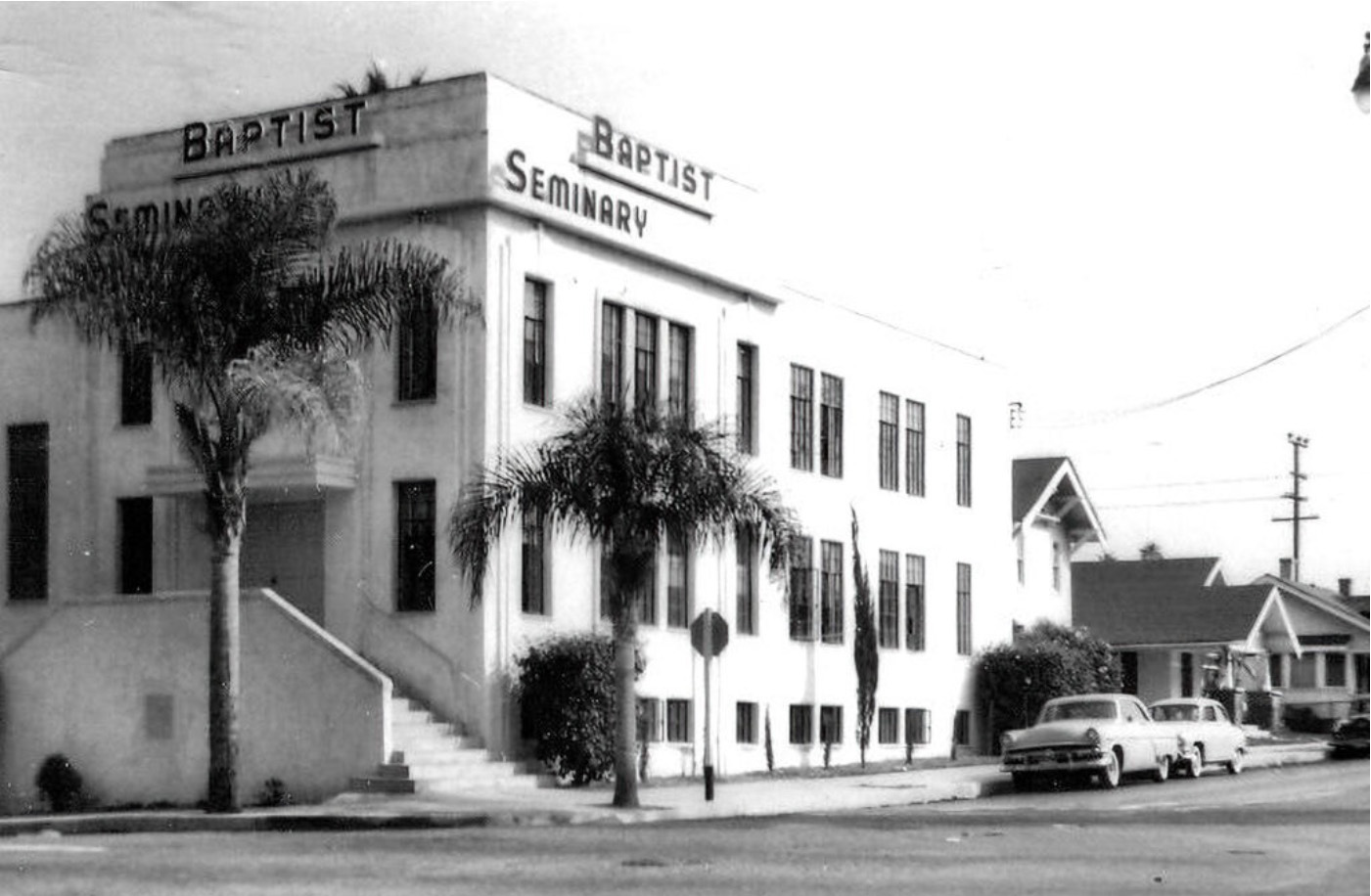
Los Angeles Baptist Theological Seminary
Old-school fundamentalism
But while MacArthur’s Baptist credentials are shaky, his connection with old-school fundamentalism is solid. The Los Angeles Baptist College and Seminary, which preceded The Master’s Seminary, was established in 1927 as an “orthodox” alternative to Northern Baptist Convention affiliated schools, like Berkeley Baptist Divinity School, which was a founding member of the ecumenical Graduate Theological Union at the University of California Berkeley. With the exception of the evangelical Northern Baptist schools, Northern Baptist Theological Seminary in Chicago and Eastern Baptist Theological Seminary in Philadelphia, the other Northern Baptist seminaries were regarded by fundamentalists as too modernist and not sufficiently orthodox to trust with the education of Baptist ministers.
LABTS proudly stood under the banner of fundamentalism. The description “fundamentalist” may have negative connotations today, but in the 1920s, it was the self-designation of those who were prepared “to do battle royale for the fundamentals of the faith” against modernism in church and society. Fundamentalists rallied to resist modernist interpretations of the faith by urging Christians to reaffirm what they upheld as the historic truths of an inerrant Bible, a virgin-born Savior, a substitutionary atonement, a bodily resurrection and a miraculous providence.
The formulation of these fundamentals, however, was a modern construction, not a statement of “the faith which was once delivered unto the saints” (Jude 3). That would be an ancient ecumenical statement, like the Nicene Creed and Apostles’ Creed.
Yet fundamentalism was not simply ideological. It transformed ideas into a social movement, and the social movement became embodied in institutions like LABTS. As dissenting churches left the Northern Baptist Convention, they formed new associations of likeminded congregations. But to ensure a future, they needed a way to educate the next generation of church leaders.
From the beginning, the mission of LABTS was to be the fundamentalist alternative for the education of Baptist ministers in the Pacific. The founding president, William A. Matthews, attended the modernist University of Chicago Divinity School, but as pastor of Memorial Baptist Church in Los Angeles in the early 1920s he stood on the side of the fundamentals. The original LABTS faculty members were Baptists and committed fundamentalists.
Matthews warned that denominational schools were making light of evangelism, denying the authority of Scripture, exalting reason and science above revelation, and making shipwreck of the faith. He told stories, like the student who entered college as a Christian. In his freshman year he accepted evolution. As a sophomore he embraced atheism. By his junior year he became president of an atheist society. Matthews concluded, “An anti-Christian spirit pervades many denominational colleges today.” He pledged that LABTS would stand on the fundamentals of the faith.
Many fundamentalist Baptists in Southern California remained connected with the new structures of Baptist organization, although some, like Jack MacArthur, left to form nondenominational churches.
“The denominational genealogy of John MacArthur is on the Independent Fundamentalist branch of the Baptist family tree.”
To put it simply, the denominational genealogy of John MacArthur is on the Independent Fundamentalist branch of the Baptist family tree. Like his father Jack, John MacArthur considered himself a Baptist in heritage and belief, but without official ties to any Baptist denomination or body. Yet he was firmly rooted in the soil of fundamentalism.
Graduates of LABTS went on to make significant contributions. Some assumed a more evangelical approach, finding good company with other Baptist evangelicals like A.H. Strong, E.J. Carnell, Carl Henry, Bernard Ramm and Billy Graham, who challenged Christians to preach and teach the good news of the gospel. Others took the approach of a more cantankerous and controversial fundamentalism doing battle royale for the old fundamentals with other Baptist fundamentalists like J. Frank Norris, William Bell Riley, John Roach Straton, Robert Ketcham and John R. Rice.
John MacArthur followed in the footsteps of the latter. He was a fundamentalist, not an evangelical. He may have gotten over being Baptist, but he never got over fundamentalism. His legacy is passing on the old battles to the next generation.

Curtis Freeman
Duke Divinity School faculty
Curtis W. Freeman serves as research professor of theology and Baptist studies and Ruth D. Duncan Director of the Baptist House of Studies at Duke Divinity School. Among his publications is Undomesticated Dissent: Democracy and the Public Virtue of Religious Nonconformity, Pilgrim Letters: Instruction in the Basic Teaching of Christ, and Pilgrim Journey: Instruction in the Mystery of the Gospel.
Related articles:
John MacArthur met his own definition of a false prophet | Analysis by Rick Pidcock
Evangelical firebrand John MacArthur dead at 86
What has John MacArthur actually said about race, slavery and the Curse of Ham? | Analysis by Rick Pidcock