


The first 346 words that follow the headline “The U.S. wealth gap presents both a political challenge and a spiritual problem” on Baptist News Global by Todd Thomason are packed with data that Christians of all stripes should carefully consider. The conclusion he lays out beginning with the subheading “Grotesque injustice” is laced with fine Scriptural references that aptly explain why Baptists and other biblical believers should be engaged in seeking solutions.
Thomason modestly admits the solution is “beyond the scope of this article and above the pay grade of the author.” He is to be commended for raising these issues, as is BNG for publishing it. That said, the middle portion starting with “Of course, this is not how the ‘Reaganomics’ experiment was supposed to turn out,” while a common refrain among numbers of thinkers, is respectfully subject to an entirely different interpretation of the facts Thompson aptly laid out.

Tony Kovach
For those who believe in providence working through free will, it surely is no coincidence that Thomason’s thesis was published at the same time as Ivory Mewborn’s op-ed on BNG relative to how affordable home ownership impacts wealth distribution.
Before proceeding, let’s stress that authentic facts are not political, although partisans may and do use them. “You will know the truth, and the truth will make you free” (John 8.32) is the Lord’s dictum that can bring together the core of what both Mewborn and Thomason laid out.
With a spirit of fraternal correction, here are some facts that Thomason and others should chew on in terms of the facts and their scriptural implication.
To briefly frame this issue historically, economically and spiritually, let’s jump back in time to the period around the U.S. revolution and the early days of the American Republic.
When the Boston Tea Party occurred in 1773, there were at least two undercurrents, one of which was related to the British crown’s tax on the tea. The other was that rebels were protesting that the tea was part of a royal grant of a monopoly.
“The American revolution was an economic, political and religious break with England.”
We must keep in mind that the American revolution was an economic, political and religious break with England. As the Declaration of Independence framed it, “We hold these truths to be self-evident, that all men are created equal, that they are endowed by their Creator with certain unalienable Rights, that among these are Life, Liberty and the pursuit of Happiness.”
While no human event, person or organization is perfect, our Republic’s revolution explicitly aimed at weaving together Godly principles with economic, political and social principles.
George Washington said in his farewell address that “of all the dispositions and habits which lead to political prosperity, religion and morality are indispensable supports. In vain would that man claim the tribute of patriotism, who should labor to subvert these great pillars of human happiness, these firmest props of the duties of men and citizens.” That principle arguably applied then, now and should until the Second Coming.
Fast forward to the debate after the American Revolution of what became our current U.S. Constitution.
On Dec. 20, 1787, Thomas Jefferson wrote his friend James Madison to say what he thought was lacking in the draft. “I will now add what I do not like. First the omission of a bill of rights providing clearly and without aid of sophisms for freedom of religion, freedom of the press, protection against standing armies, restriction against monopolies … .” That “restriction against monopolies” was followed by “trial by jury in all matters” — checks on government and economic power.
We know that most of these suggestions made by Jefferson were adopted, but the check against monopoly power only came decades later.
“The check against monopoly power only came decades later.”
Jumping ahead to the 1800s, there were various economic and political battles in America over banking, finance and economic issues.
After the Civil War and the freeing of slaves, there was a battle over monopoly power. Sen. John Sherman famously said, “If we will not endure a king as a political power, we should not endure a king over production, transportation and sale of any of the necessaires of life.”
It is not easy for most who have not studied the harms caused by monopolistic forces to realize just how pernicious they can be.
For an expert view from the Minneapolis Federal Reserve, James A. Schmitz Jr. and David Fettig are among economic researchers that noted that monopolies can become “Silent Spreaders of Poverty and Economic Inequality.” This pattern of what they dubbed “sabotaging monopolies” may subtly or obviously impact housing, health care and several other segments of the economy. Like Mewborn, Schmitz and others have advocated on behalf of a greater access to more manufactured homes.
As a disclosure, Mewborn and this writer — while independent of each other — produced a joint statement that reveals how existing federal laws could be used to overcome artificial zoning barriers.
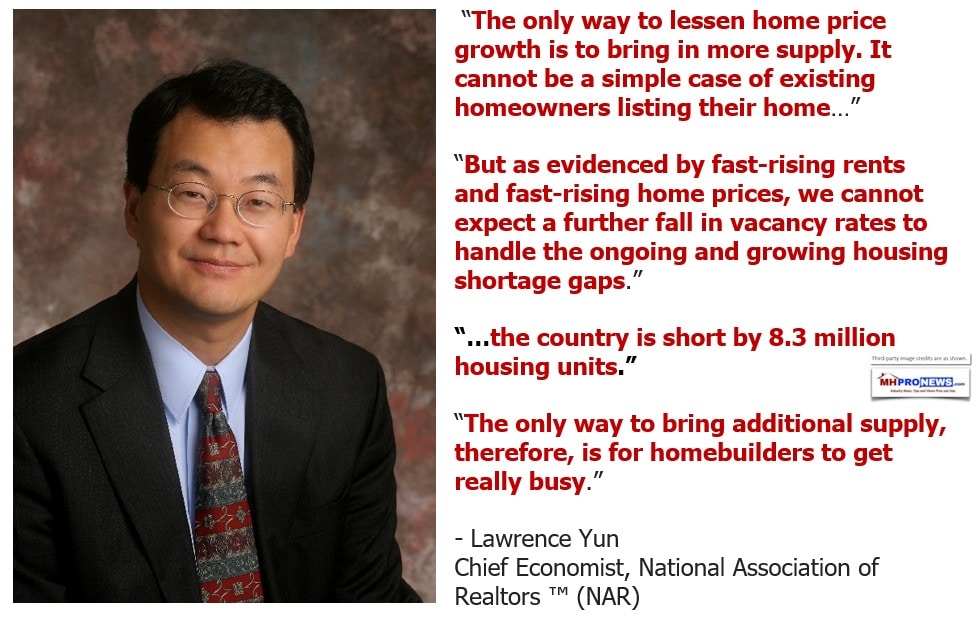
That said, Mewborn was quite correct in saying that manufactured homes are an attainable “home ownership” option that “is a proven and common tool for building generational wealth. The nation’s affordable housing crisis is raging, and the only solution is to provide more new housing that is affordable.” Lawrence Yun with the National Association of Realtors said something similar.
Citing a range of important facts and evidence that support Mewborn’s thesis, former HUD Secretary Ben Carson praised manufactured homes as an achievable means of building that generational wealth.
Let’s draw to a close by pondering for a few moments what Jesus did in what’s sometimes called “the cleansing of the temple.” Why did the Lord drive those merchants and traders out with a makeshift whip?
“Monopoly power is fundamentally a corrupt collusion between government and big businesses.”
Several Scriptural reasons come to mind, including violations of the principle of “unjust weights and measures,” (Leviticus 19:35; Proverbs 11.1; Luke 16:10, James 5:4). By word and example, Jesus’ statement that “you have turned my Father’s House into a den of thieves” (Matthew 21:13) rebuked corrupt and harmful business practices. That divine teaching can easily be applied, as the founders did, to the evils of monopolization.
Monopoly power is fundamentally a corrupt collusion between government and big businesses, as Schmitz and others have evidenced.
The pragmatic answer is for people of faith to gain understanding, see harms and patterns, and advocate solutions possible by enforcing existing laws.
What Jefferson and Sherman sought in antitrust (think anti-monopoly) restrictions was a balance that protected small businesses, small farms and the rights of the employed.
Free markets and free people are the happy middle between the extremes of socialism, communism and the fascist model of big business and big government colluding to control “we the people.” John 8.31, cited above, is often overlooked in the light of verse 32. “You are truly my disciples if you remain faithful to my teachings.”
L.A “Tony” Kovach is a former youth minister and online evangelist, is an acknowledged expert in manufactured housing, and is the publisher of MHLivingNews.com and MHProNews.com. He has won numerous awards in history, including the Lottinville Award from the University of Oklahoma.
Related articles:
The U.S. wealth gap presents both a political challenge and a spiritual problem | Analysis by Todd Thomason
Manufactured homes and just zoning laws can transform working poor | Opinion by Ivory Mewborn
It is impossible to afford rent almost anywhere in the U.S. with a minimum-wage job