

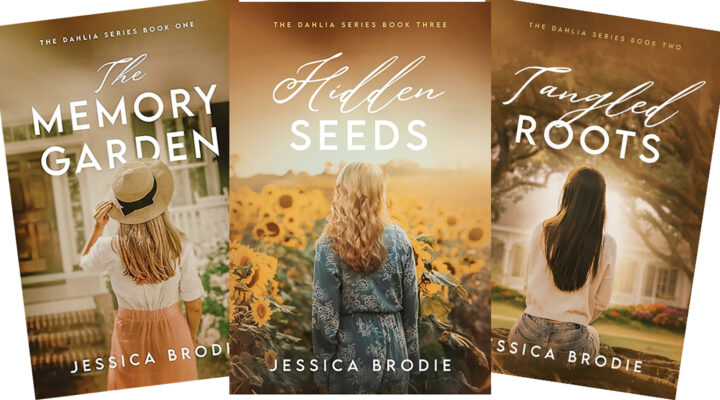
United Methodist novelist Jessica Brodie always starts her stories with the characters. Her strategy has proved successful, since her third novel recently topped Amazon’s bestseller list for new releases in Christian fiction books.
“I write redemption stories about people who go through hard times,” Brodie said. “Maybe they’ve made big mistakes, but through Jesus they figure out who they are and make a way.”
The tagline for her novel series encapsulates their overall theme: “Where grace meets grit.”

Jessica Brodie
Known as an award-winning religion communicator, Brodie’s “day job” is as editor of the South Carolina Advocate, the news journal of the South Carolina Annual Conference of The United Methodist Church. She holds a master of arts degree in English and graduated magna cum laude with a bachelor of science in communications/print journalism from Florida International University. She’s also been a college writing instructor and still coaches writers.
“Working for the Advocate for 16 years, I’ve grown as a person so much from telling other people’s stories,” Brodie said. “So much of what I write in the Advocate inspires what’s in the novels.”
An avid reader and writer “since I could first hold a pencil” at age 2, Brodie said her passion for writing developed throughout her life. She wrote her first unpublished novel at age 21 and another unpublished work at age 29. However, it wasn’t until “God gave me a novel” in her late 30s that she was led to write from her Christian faith.
She plans her novel-writing times around Advocate duties, along with being a mother and stepmother of four teenagers and spouse of another noted United Methodist communicator, videographer and media specialist Matt Brodie. Together the Brodies also run a media consulting company.
Brodie said she was a “shy child” who barely spoke until she discovered drama in high school: “Drama gave me a way to relate because it was all about taking on another character.”
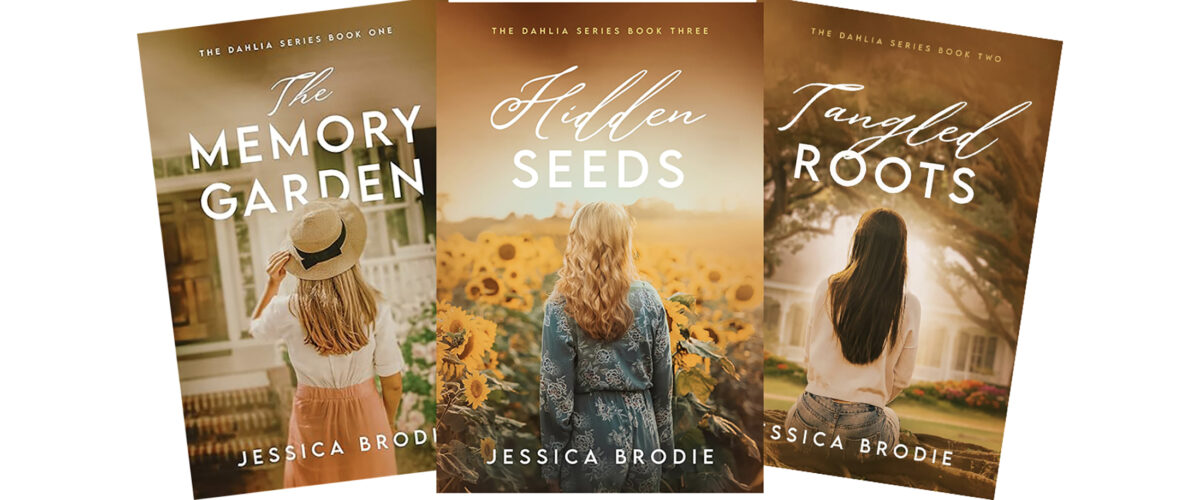
Brodie’s three novels — The Memory Garden, Tangled Roots and Hidden Seeds — are set in the fictional small town of Dahlia, S.C. Amid their typical small-town atmosphere, her novels focus on the characters and their conflicts.
“I imagine characters as if I’m wearing them as a cloak,” the author explained. “For example, in my first book, The Memory Garden, there’s an 11-year-old African American boy. In my second, Tangled Roots, there’s an incarcerated white male.
“Some writers start from plot, but I begin with my idea for a character and the predicament they’re in, what they have and don’t have. It’s like a big algebra equation for me, and it’s lot of fun.”
Her characters “inhabit” their author while she’s writing, she said. “The things they like, I like while I’m writing them.”
Her real-life experiences, while significant inspiration, are highly fictionalized for her novels.
For example, she accompanied her husband on a video shoot to Killingsworth Home for Women in Columbia, S.C, which describes its mission as “to support, to empower and advocate for women recovering from various life crises within a safe, nurturing, Christian environment.” That visit and subsequent volunteering with Killingsworth led to a setting for her third book, Hidden Seeds.
In that story, the two female protagonists, Natalie Motts and Laney Ricks, are struggling to recover from the wreckage of their lives when Natalie’s teenage sister Hayley vanishes, “and all signs point to a local human trafficking ring,” says the Amazon synopsis. Laney’s experience as a trafficking survivor confronts her with a dilemma: Should she keep silent and protect her fragile new safety or share her experience with Natalie, her employer, to help find and save Hayley?
Like the characters in her novels, the author knows life’s obstacles require perseverance.
“I work with people who are discouraged because they can’t find a publisher or an agent,” Brodie said. “It took me 29 years, so I tell writers to keep trying. I say to writers, ‘Tell your story with gusto. Don’t let your doubts hold you back. Show it to as many people as you can; have it edited as best you can. Think of your story like Jesus’ parable of the talents. Take whatever story God gives you and do as much with it as you possibly can.’”