

 Americans are a remarkably faithful people when it comes to spirituality, yet they are simultaneously, remarkably faithless when it comes to institutional religion. Why? This perplexity borders on cliché since it has been true for a number of years, but it came up again this week in data.
Last week, Barna released its annual “State of the Church” report, and it had “good (and bad) news about the state of American faith.” Barna’s researchers found that 73 percent of Americans confess that religious faith is important to their life (77 percent in the Pew survey); and yet, Barna also found that a mere 31 percent of Americans attend a religious service once or more a month.
There are two ways of interpreting that seemingly perplexing bit of data. Consider Barna’s take first. Barna stipulates that “a more accurate picture of Christian faith in America” involves a “triangulation of affiliation, self-identification and practice,” whereas Barna defines “practice” as attending a religious service at least once a month. The 73 percent figure decreases to 31 percent after the triangulation. The logic is relatively clear: one can identify as Christian and even say faith it is an important part of their life, but that does not necessarily make one a practicing Christian. The thing that makes one a practicing Christian is going to church once a month or more.
Surely, at some point you need a clear metric to gauge someone’s faith in data, but I wonder if this assumption is a bit wrong-headed. What if Americans are not being disingenuous about their religious convictions (as Barna perhaps implies) but that church attendance no longer necessarily correlates with religious conviction?
As leaders in institutional religion, that is a scary question. Put another way, it is even more formidable. What if Americans are not lying? What if church does not matter to them because church doesn’t matter? I do not mean that in an existential sense — I believe church matters. If I did not think church mattered, this millennial would not have spent seven years getting a bachelor’s degree in religion and a master’s degree in seminary. If I did not think church matters, I would not have been ordained, worked in and for, and continued to seek service in church. Nevertheless, we owe it to ourselves as religious professionals — and as church-going people in general — to ask the question. What if church doesn’t matter to people because church, as it materially exists in our present moment, doesn’t matter?
What would a church that mattered look like for these scores of Americans who value their faith but do not necessarily value attending a church or place of worship? If church attendance no longer correlates with religious conviction, what might church need to look like to change that?
One of the bits of data in the Landscape Study that continues to captivate me is the percentage “of adults who feel a sense of wonder about the universe.” According to Pew, 75 percent of Americans report experiencing this phenomenon at least several times a year. We shouldn’t make a false equivalency with the 77 percent of Americans who report that faith is importation to them — it may not necessarily be the same people — but there has to be some overlap. But how often do people experience this wonder in our churches? How could they?
Additionally, 83 percent of Americans report feeling “a sense of spiritual peace and wellbeing” at least several times a year. But is that one of the things churches pursue? Is that a priority in our worship planning, our retreat organizing, or even in our small groups and Sunday Schools? This is obviously an important facet of the American religious experience, but what are we doing about it? Exercise regimens like SoulCycle or CrossFit emphasize this kind of spirituality better than we do. Practices like mindfulness meditation, types of yoga, or even the explicitly Christian Taizé chanting could achieve this in our churches.
The Barna report points out that close to 40 percent of Americans see their faith exercised in some sort of act of service. We often see mission work as an outcome of spiritual formation, at best, or a necessary requirement of a healthy relationship with God. What if we saw missional work as spiritual formation instead? What if missional work was less of a tacked-on option in our churches and more a central avenue to express your faith? The Barna report suggests such a direction might be in line with Americans’ experience of faith already.
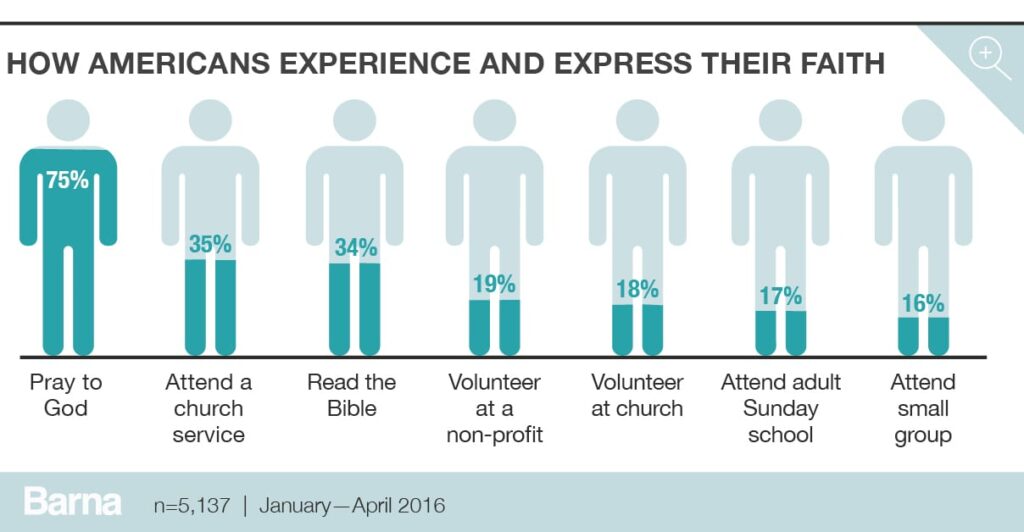
We could do wonders for our churches if we stopped worrying about declining church attendance and worried instead about how much our churches vitalize (or not) the spiritual lives of everyday people. We could stop asking why people are leaving church and start asking why they should be coming in the first place. It’s not “Why doesn’t church matter to them?” but “Why should church matter to them?”
The point is not to revamp a seeker-sensitive church movement that turns Christian communities into commodities or service industries. Rather, we often assume (tacitly or explicitly) that our churches are innately authentic expressions of faith and we just need to try to get people’s faith to match that expression. We just need to make church more appealing.
What if we turned the question on its head and asked instead: what is God already doing in the authentic spiritual lives of people that our churches are ignoring? Maybe the future of our churches looks less like getting people to fit into our existing religious paradigms and more like trying to figure out what God is already doing in their lives without us.