


History is filled with oppression — nations rising on the backs of slaves, governments entrenching inequality and cultures ignoring the cries of the vulnerable. For centuries, people have been stripped of dignity, denied opportunity, education, health, resources and forced into cycles of suffering.
Yet Scripture rings with a consistent theme: God sees the oppressed, hears their cries and acts with justice. In Exodus 3:7-8, God says, “I have surely seen the affliction of my people… and have heard their cry… I am come down to deliver them.” These words reveal God’s heart for every generation, including our own.
Oppressive systems appear immovable, but God’s justice always prevails. Proverbs 22:22-23 warns, “Do not exploit the poor… for the Lord will take up their case.”

Monica Davis and Edmond Davis
Habakkuk 2 condemns those who build wealth on exploitation, promising collapse. From Pharaoh’s Egypt to Babylon’s empire, injustice eventually faces God’s judgment.
Yet God’s promise goes beyond survival. God restores. Isaiah 61:7 promises, “Instead of your shame you shall have a double portion.” Deliverance means not just freedom from chains, but dignity, provision and hope.
This scriptural backdrop sets the stage for today’s question: What would America look like if Donald J. Trump, or any president, truly followed Jesus Christ?
American politics often claims the language of faith. Leaders cite Scripture, court Christian voters and promise “values-based” governance. However, when weighed against New Testament values — such as mercy, humility, truth, justice and care for the vulnerable — the results reveal contradictions.
Policies that echo biblical values:
- Criminal justice reform: The First Step Act of 2018 reduced mandatory sentencing minimums and expanded rehabilitation. Matthew 25:36 commends remembering the prisoner and offering second chances aligns with redemption.
- Support for HBCUs: Trump played a role in helping to secure permanent funding for Historically Black Colleges and Universities, long underfunded. During his second term, however, funding was cut from HBCUs. Galatians 6:10 urges believers to “do good to all,” especially to marginalized communities.
- Pro-life advocacy: Trump’s vocal opposition to abortion reflects Psalm 139’s image of God knitting life in the womb, resonating with many Christians’ defense of unborn children.
- Religious liberty: Despite some problems today, his administration earlier expanded protections for the expression of faith in workplaces and schools, echoing the early church’s freedom to gather and pray (Acts 2:42).
Policies that clash with Jesus’ teachings:
- Family separation: Trump’s 2018 policy at the border tore children from parents. Jesus’ words in Matthew 19:14 — “Let the little children come to me” — condemn such cruelty.
- Travel ban: Targeting predominantly Muslim countries contradicted the parable of the Good Samaritan (Luke 10), which calls for compassion beyond tribe and religion.
- Cuts to social safety nets: Restricting aid for the poor conflicts with Matthew 25:35-40, where Christ identifies himself with the hungry and homeless.
- Environmental rollbacks: Withdrawing from the Paris Climate Accord ignored Genesis 2:15’s command to steward creation.
- Attacks on DEI: Efforts to dismantle diversity and equity programs disregarded Galatians 3:28’s vision of unity in Christ.
- Culture of falsehood: Trump’s record of misleading claims collides with John 8:32: “The truth will set you free.”
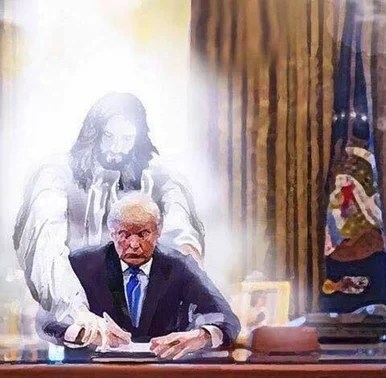
Fan art showing Jesus guiding President Donald Trump.
Between these extremes lies a mixed record. The 2017 Tax Cuts and Jobs Act provided relief to some but favored the wealthy, contradicting Acts 4:34-35’s model of shared provision. “Pro-life” policies raised valid concerns for the unborn but often lacked compassion for mothers in crisis.
Leadership, in the New Testament view, is measured not by partisanship but by service, humility and truth. Would the same record of lawbreakers be pardoned by Trump again if he followed Jesus Christ?
Trump has publicly used the name of Jesus a handful of times during and after his presidency. He invoked Jesus in Easter and Palm Sunday remarks, at a National Day of Prayer service, and he once quoted Jesus in the context of foreign policy. He also referenced Jesus during a 2024 Dr. Phil interview and controversially compared his own struggles to Christ’s suffering. Beyond these few instances, most mentions came from speechwriters or clergy around him rather than Trump himself.
If Trump — or any American leader — fully embraced Christ’s teachings in office, our politics would look different. Policies would prioritize children at the border, the poor in our cities, the stranger at our gates. Stewardship of the earth would be a sacred duty, not a partisan debate. Economic systems would uplift the least advantaged rather than rewarding only the wealthy. And truth, not misinformation, would guide leadership.
The Sermon on the Mount (Matthew 5) provides the ultimate test: Blessed are the merciful, the peacemakers, the humble and those who hunger for righteousness. A Jesus-following commander-in-chief would write an executive order for the Pentagon (Department of Defense) to be renamed Department of Peace, not “Department of War.”
Imagine a White House guided by those words instead of division, pride or war. America might resemble Revelation 7:9’s vision — “a great multitude … from every nation, tribe, people and language” standing together in hope.
This is not about left or right, Democrat or Republican. It is about whether leaders reflect the justice, compassion and truth of Jesus Christ. Oppressors may rise, but God promises judgment. Communities may struggle, but God promises restoration. For Christians, political loyalty must never outweigh spiritual integrity.
If Donald J. Trump truly followed Christ, America would be more just, more compassionate, more united and more truthful. That is not just a critique of one man, but a challenge to all leaders — and to all citizens of faith.
The question remains: What would America look like if we followed Jesus more closely?
Edmond W. Davis, international speaker, and Monica Davis, nonprofit leader, are devoted believers in Jesus Christ and a happily married couple. Together, they bring nearly 50 years of combined experience as professional educators. They are the founders of Aviate Through Knowledge and co-authors of the Amazon No. 1 new release, GROWTH MINDSET: Developing a Growth Mindset to Respond-Responsibly. Deeply rooted in faith and community, they are proud members of Bountiful Blessings World Fellowship Church in Little Rock, Ark.